
Termite Guide · Hinesville, GA · Wood-Destroying Beetles
Powderpost Beetles in Hinesville, GA: Tiny Holes, Fine Powder & How to Treat Them
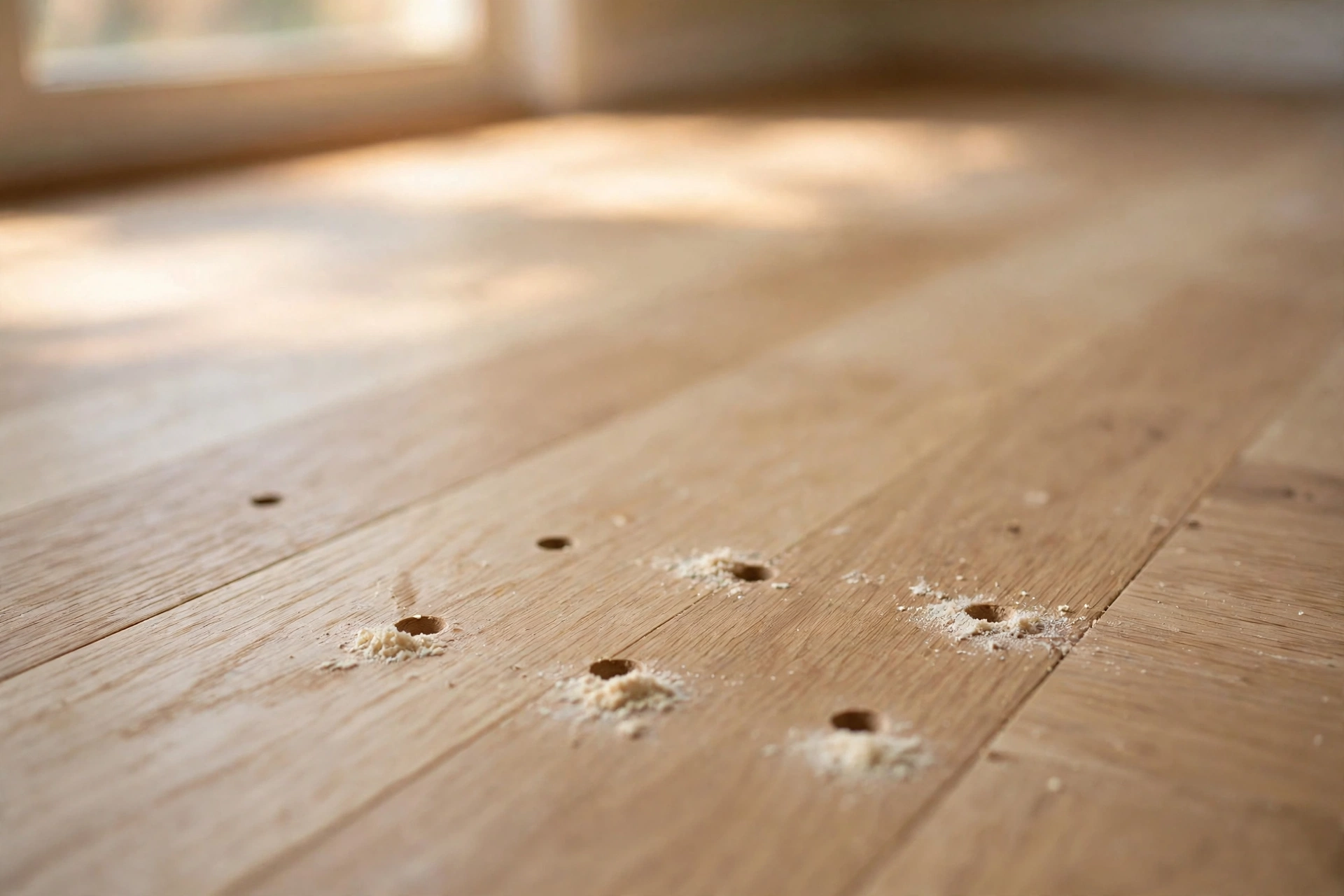
Tiny round holes appear in a hardwood floor, with a little pile of powder as fine as flour underneath each one. No mud tubes, no ants, no beetle in sight. That is the powderpost beetle signature, and it is easy to misread: the damage is done out of sight, over months or years, by larvae inside the wood. Here is which beetle you have, how to tell it from termites, and which fix actually lasts in coastal Georgia.
Key Takeaways
- Powderpost beetle is not one beetle. Three groups matter: lyctid (true powderpost, hardwoods only), anobiid (furniture/deathwatch, softwoods and hardwoods, structural), and bostrichid (false powderpost). The group decides the fix.
- The powder tells you the group. Lyctid frass is flour- or talc-fine and pours freely from tiny 1/32 to 1/16 inch holes. Anobiid frass is grittier, with small pellet shapes. Termite evidence is mud tubes or hard pellets, never flour-fine powder.
- The larvae do the damage, unseen, for months to years. By the time holes appear, the beetle has already lived in the wood for a year or more.
- Surface spray on finished wood does not reach larvae inside. Borates only work on unfinished wood, replacement works for limited pieces, and fumigation kills everything but prevents nothing.
- Moisture is the long-term lever, especially for anobiids in crawlspaces. Dry the wood, seal the wood, and the beetles lose their foothold.
What Is a Powderpost Beetle?
Powderpost beetles are small wood-boring beetles whose larvae tunnel through wood and reduce it to a fine powder, called frass. The adults are small, reddish-brown to black, elongated and flattened, usually 1/16 to 1/4 inch long, and you will rarely see one: adults are attracted to light and windows, emerge, mate, lay eggs, and are gone, while nearly the whole life cycle happens inside the wood. They do not bite, sting or transmit disease. The damage they do is to wood, slowly and quietly, and the University of Kentucky entomology program ranks powderpost beetles second only to termites in their ability to damage dry, seasoned wood.
Three groups are grouped under the powderpost name, and Extension publications stress identifying the group first, because management options vary by species. The table below is the fastest way to do it, from Texas A&M AgriLife Extension publication E-394 and North Carolina State Extension.
| Group | Wood attacked | Exit hole | Frass | Life cycle |
|---|---|---|---|---|
| Lyctid (true powderpost) | Hardwood sapwood only: oak, ash, hickory, walnut, bamboo | Round, 1/32 to 1/16 inch | Flour- or talc-fine; pours freely from holes | 3 months to 1 year, typically 9–12 months |
| Anobiid (furniture / deathwatch) | Softwoods and hardwoods, including structural timber | Round, 1/16 to 1/8 inch | Fine to coarse, gritty, small pellet shapes; little at exit holes | 1–3 years, often 2+ years |
| Bostrichid (false powderpost) | Hardwoods and tropical hardwoods, bamboo | Round, 1/8 to 3/8 inch | Fine to coarse, tightly packed, tends to stick together | Usually about 1 year |
In Georgia homes, the split usually runs like this. Lyctids are the flooring, trim, cabinet and furniture beetle: they infest only hardwoods, and the University of Georgia's entomologist Dan Suiter says the lyctid causes the most problems for homeowners because its food source is hardwood, getting about 10 calls a year from people with powderpost beetles in hardwood floors, picture frames, bannisters or molding. Anobiids are the structural concern: in North Carolina, the primary concern is anobiids attacking the softwood conifers, spruce, pine and fir, used for floor joists, wall studs and other structural lumber, and in coastal Georgia the same damp-crawlspace pattern applies. If the holes are in pine framing, it is not a lyctid, because lyctids do not attack softwood at all.
What Are the Signs of Powderpost Beetles?
Look for the holes and the powder, not the beetle. Small, perfectly round exit holes in the wood surface, with fine powder sifting from the holes and collecting beneath them, are the signature. Lyctid holes are pinhead-sized, 1/32 to 1/16 inch, and the powder feels like flour or talc between your fingers. New holes with fresh powder mean the infestation is active. Old holes with no new powder may be old damage, and an inspection is what settles it.
Homeowners usually discover an infestation by finding signs of damage rather than the insect itself. Extension guidance lists the signs to check: the holes beetles leave when they emerge, powdery frass that piles below the holes or collects in cracks, stained or blistered wood surfaces where larvae tunneled just below the surface, and sometimes an audible rasping or ticking sound from larvae chewing. Adult beetles may turn up at windows and doorways, drawn to light. Larvae themselves stay inside the wood: elongated, segmented, soft, fleshy white to cream-colored grubs with a distinct brownish hardened head capsule, tiny to more than 2 inches long depending on the group.
The frass test is the field check anyone can do. Put a sheet of paper under the holes, tap the wood, and look at what falls. Fine as flour or talc, pouring out freely, points to lyctid. Powdery but gritty, with tiny pellet shapes, points to anobiid. Packed tight, refusing to fall out even when tapped, points to bostrichid. Note the hole size too: only the tip of a ballpoint pen fits a lyctid hole, while the pen tip and part of its angled face fit an anobiid hole. Photograph the holes with a coin for scale before you clean anything, so an inspector can see the hole size and frass texture as you found them.
Where you find the signs matters as much as what they look like. Hardwood floors, stairs, paneling, trim, built-in cabinets and furniture, especially imported pieces, point to lyctids. Floor joists, subflooring, wall studs and other structural timber in a damp crawlspace or basement point to anobiids. Bamboo flooring and furniture can host lyctids and bostrichids. A single piece of furniture with holes may be a problem that arrived with the furniture, not a problem in the house at all.
Powderpost Beetles vs Termites: How Do You Tell?
Both reduce wood to dust, and both are found on wood-destroying-organism reports, but they are different insects with different fixes, and treating one like the other wastes money. The debris is the fastest tell: fine powder under round holes points to beetles, mud means termites, and coarse sawdust mixed with insect parts means carpenter ants.
| Sign | Powderpost beetles | Subterranean termites | Carpenter ants |
|---|---|---|---|
| Visible sign | Round exit holes + fine powder | Mud tubes + clean internal galleries | Smooth, clean galleries, ants foraging at night |
| Debris | Flour-fine powder (lyctid) or gritty frass with pellets (anobiid) | No visible frass; mud-packed tunnels | Coarse frass with insect parts |
| Eats wood? | Larvae feed inside the wood | Yes, as food | No, tunnels only to nest |
| Holes | Small round exit holes, uniform size | No surface exit holes; mud tubes on walls and foundations | No exit holes; smooth galleries |
| Wood preference | Hardwood sapwood (lyctid) or damp structural timber (anobiid) | Any cellulose-containing wood, soil contact | Moist or water-damaged wood |
Drywood termites are the other confusion, and the frass separates them too. Drywood termites push hard, six-sided, uniform pellets out of small kick-out holes, often resealed, and their galleries cut across the grain. Powderpost frass is powder, not hard pellets. If you are finding hard, uniform pellets rather than powder, you are probably looking at drywood termites, and our termite control page and termite swarmers guide are the right next reads. When the signs are mixed, or the wood is structural, a professional inspection is what resolves it: the hole size, the frass texture and the wood species together identify the pest, and no single sign does it alone.
How Long Do Powderpost Beetles Live in Wood?
Long enough that the first holes are old news. The adult beetle lays its eggs on unfinished wood, in pores, cracks, crevices or old exit holes. The female favors open-pored woods like red oak and ash, where she can reach into the pores, and she lays 10 to 50 eggs. The eggs hatch in about 10 days in warm weather, and the small cream-colored larvae tunnel through the wood, feeding on the starch, sugar and protein in the sapwood, the soft outer layer just below the bark. They pupate inside their galleries, then chew their way out as adults, which is what makes the exit hole and defaces the wood.
Lyctid beetles may complete the cycle in as little as three months, but more typically 9 to 12 months, and sometimes longer, depending on temperature, humidity, moisture and the starch content of the wood. Anobiids usually take 2 or more years. Wood is poor nutrition, so the beetles compensate with lengthy life cycles: the University of Georgia notes the lyctid life cycle is measured in years because wood is not a good source of nutrition. Adults emerge in late winter and spring, which is when homeowners usually first notice the holes and the powder, but the beetle had actually been living inside the wood for a year or more by then.
Moisture sets the limits. Lyctids need wood moisture of at least 8 percent and can attack wood from 8 to 30 percent moisture, which is why even kiln-dried hardwood is not safe once it is stored or installed in a humid home. Anobiids need more: wood moisture levels closer to 13 percent become less favorable to them, and infestations are worst where wood stays damp, in crawlspaces, basements and garages with poor ventilation. As wood ages, its starch content declines, which is one reason lyctid infestations in finished, centrally heated, low-moisture wood tend to fade over time, and why most heavy infestations show up in wood less than 10 years old.
Is My Infestation Active or Old Damage?
Holes alone do not prove activity. Holes are history: they show a beetle left, not that one is still inside. The test is fresh powder. Clean the powder away completely, mark the date, and check again over the following weeks, during the emergence season. New piles of powder under the same holes, new holes appearing, or live beetles at windows and lights mean the infestation is active. No new powder, no new holes and no beetles over a full season point to old, inactive damage, though only an inspection with a moisture reading and a look at the wood species settles it for a report or a sale.
Do not mistake the source. Beetles enter wood shortly after it is processed and before a finish is applied, so holes in a new floor may mean the infestation arrived with the lumber, not that the house is infested. Lyctids rarely re-infest finished wood indoors that has low moisture and declining starch, so a few boards with old holes may need replacement, not a whole-house treatment. Anobiid damage in structural timber is different: if the moisture that allowed it is still there, the infestation generally will not fade on its own. That is why the moisture reading matters as much as the hole count.
If the wood is structural, sounds hollow, flakes or breaks under a probe, or the damage is spreading, do not wait out a season to decide. Get the inspection first, and keep the frass and hole photos for it. An inspector can confirm the group, the activity and the moisture, and document the findings for a wood-destroying-organism report.
How Are Powderpost Beetles Treated?
There is no single powderpost treatment, because the group, the wood and the finish decide what can reach the larvae. Surface products cannot reach larvae tunneling inside wood, and finished wood cannot be treated with borates at all. The options below are the ones Extension and industry guidance actually lists, in order from the most targeted to the most drastic.
| Option | When it works | Limit |
|---|---|---|
| Replace the wood | Infestation limited to a few boards, trim pieces or furniture | Not practical for widespread structural damage |
| Borate treatment | Accessible, unfinished wood; licensed operator applies it | Needs bare wood; shallow penetration in dry wood |
| Heat treatment | Furniture and small wood items in a heat chamber | Must heat the whole piece through; not for a house |
| Moisture control | Anobiids in damp crawlspaces and basements | Slow; fixes the cause, not the larvae already inside |
| Fumigation | Widespread or inaccessible structural infestation | Kills all stages, but no residual; reinfestation possible |
Replacement is the most direct fix for limited damage, and the University of Georgia calls it the most economically feasible remedy for lyctids in flooring or trim: replace the infested pieces and the adjacent ones, with kiln-dried lumber, and check whether the hardwood purchase carries wood replacement insurance. It works well for lyctids because they do not readily re-infest finished, low-moisture wood indoors. Remove and destroy infested structural wood by burning or landfill, and do not stack it against the house.
Borate treatments, such as Bora-Care and Tim-Bor, are the main liquid option, and they must be applied by a licensed pest control operator to bare, unfinished wood. Borates must penetrate the wood to kill larvae inside, and penetration is better in moist wood: if moisture is under 15 percent, penetration may reach only the top 1/4 inch. A finished floor must be sanded before a borate spray is applied, and since reinfestation of finished flooring by emerging lyctids is unlikely when moisture is low, sanding and borate application may not be necessary at all. Because the life cycle runs 9 to 12 months or longer, beetles may keep emerging for a while after treatment; the eggs and new larvae then contact the borate and die, so emerging beetles after treatment do not by themselves mean the treatment failed.
Heat kills all stages when the whole piece reaches temperature: properly kiln-dried lumber kills eggs, larvae and adults, and infested furniture can be placed in a heat chamber that heats the wood to about 135°F for up to 24 hours depending on thickness. Small items can be heated at 120 to 140°F for 6 hours, or frozen at 0°F for 72 hours, with thicker wood needing longer. Whole-structure fumigation, with a sealed tarp and evacuation, kills all life stages in inaccessible wood, but it is non-residual: it does not prevent reinfestation, and a new infestation can start as soon as the fumigant is gone. Fumigation must be done by a certified operator with a fumigation license, and it is the last resort, not the first call.
How Do You Prevent Powderpost Beetles?
Prevention starts before the wood comes in the door, because beetles enter wood while it is drying, stored or shipped, and emerge later from finished flooring, paneling or furniture. Inspect lumber, furniture and wood items before bringing them in, look for exit holes and frass, and do not bring in suspect pieces without checking them. Buy kiln-dried lumber from a supplier you trust, and ask about wood replacement coverage. Keep firewood outside and bring in only what you will burn that day.
Finish the wood. Wood finish deters the female beetle from laying eggs, because she needs pores, cracks and crevices to reach, and paint or varnish seals them. Sanded and varnished wood is far less attractive to egg-laying adults, and they cannot find the cracks to deposit eggs in. Larvae already inside can still chew their way out through a finish, so finishing prevents the next generation, it does not cure the one inside.
Control moisture, especially under the house. Reduce moisture in the crawlspace by improving ventilation and installing a 6 to 8 mil plastic moisture barrier covering 70 to 80 percent of the soil, which reduces crawlspace moisture and helps prevent anobiid infestation. Fix leaks, grade soil away from the foundation, and keep wood moisture closer to 13 percent or below where anobiids lose their footing. In a heated, air-conditioned home with no moisture problem, lyctids rarely re-infest, and finished wood stays finished.
What If Powderpost Beetles Show Up on a Home Inspection?
Powderpost beetles are a wood-destroying organism, so they show up on the wood-destroying-organism (WDO) inspection reports used in Georgia home sales, alongside termites and wood-decay fungi. What matters on a report is not the word powderpost, but whether the activity is active or inactive, which group it is, and whether the wood is structural. Active anobiid damage in floor joists with high moisture readings is a different negotiation from old lyctid holes in a few floorboards with no fresh frass.
If you are buying, ask for the inspector's evidence: hole size, frass texture, wood species, moisture readings, and whether fresh powder was found. Get a written treatment and repair quote that separates replacement, moisture work and any chemical treatment, so the numbers reflect the actual job, not the scariest one. If you are selling, the same evidence helps: a clean inspection after replacement and moisture work, with dated photos showing no new frass, is worth more than a promise that the holes are old. Do not paint over holes or clean away frass before the inspection: the inspector needs the evidence as found, and a fresh coat of paint over active holes hides the signs without stopping the larvae.
Call (912) 205-2930 for a wood pest inspection in Hinesville before you sign anything. We identify the group from the holes, frass and wood, read the moisture, and tell you in writing whether it is active, what it will take to fix, and what can wait.
What Are the Most Common Powderpost Beetle Mistakes?
- Spraying finished wood. Surface spray sits on the finish and never reaches larvae tunneling inside. Borates need bare wood to penetrate at all.
- Painting over active holes. Paint seals pores against the next generation, but larvae already inside chew out through it, and the inspection evidence is hidden.
- Treating beetles like termites. A soil barrier or bait system does nothing for beetles in hardwood floors, and a borate spray does nothing for a termite colony in the soil.
- Fumigating and stopping there. Fumigation kills everything and prevents nothing. Without sealing and moisture control, the next beetles move in as soon as the gas is gone.
- Ignoring the crawlspace moisture. Anobiid damage in structural timber will not fade while the wood stays damp. Dry the crawlspace or the beetles return.
- Panicking over old holes. Old lyctid holes in finished, low-moisture wood often need a few replacement boards, not a whole-house treatment. Confirm activity first.
Frequently Asked Questions
Do powderpost beetles bite or spread disease?
No. Powderpost beetles do not bite, sting or transmit disease to people or pets. They are a wood problem, not a health problem. The risk they carry is structural and financial: larvae tunneling through hardwood floors, trim, furniture or, in the anobiid case, structural timber, weakening the wood from the inside over months or years. If someone in the home is worried about bites or rashes, the cause is a different pest, and the powder and holes point to beetles only because the wood is the evidence.
How do I know if a powderpost beetle infestation is active?
Check for fresh powder. Clean all the frass away, note the date, and look again over the following weeks during the emergence season. New piles of powder under the same holes, new holes appearing, or small beetles at windows and lights mean the infestation is active. No new powder, no new holes and no beetles over a full season point to old, inactive damage. Hole size, frass texture, wood species and a moisture reading together confirm it, which is why an inspection is the step that settles active versus inactive for a report or a sale.
Can powderpost beetles spread to the rest of the house?
It depends on the group. Lyctids rarely re-infest finished wood indoors that has low moisture and declining starch content, so a lyctid problem in a few floorboards usually stays in those boards. Anobiids are different: where wood stays damp, in a crawlspace or basement, they can keep re-infesting structural timber for years, because the moisture that allowed them is still there. Bostrichids sit in between. The spread question is really a moisture question, and the moisture reading under the house answers it.
Will powderpost beetles go away on their own?
Sometimes, and sometimes never, which is why the group matters. Lyctid infestations in finished, centrally heated, low-moisture wood tend to fade as the wood's starch content declines and the finish blocks new egg-laying, though the larvae already inside still emerge over the next year or so. Anobiid infestations in damp structural wood generally will not fade on their own, because the moisture conditions that allowed them are still there. Do not assume either outcome: confirm the group and the moisture, then decide.
How much does powderpost beetle treatment cost in Hinesville?
It depends on the group, the extent and the wood, and that is why the first step is identification, not a price. Replacing a few infested boards is the smallest job. A borate treatment on accessible unfinished wood is priced by the area and the preparation, including any sanding of finished surfaces. Heat treatment is priced per item. Whole-structure fumigation is the largest job and is reserved for widespread or inaccessible infestation. A written quote should separate replacement, moisture work and chemical treatment, and say which parts are included, before work starts.
Does fumigation prevent powderpost beetles from coming back?
No. Fumigation kills all life stages in the wood, including larvae buried deep inside, but it leaves no residual protection, and a new infestation can start as soon as the fumigant is removed. What prevents a return is what happens after fumigation: sealing pores and cracks with a finish, replacing infested wood with kiln-dried lumber, and controlling moisture, especially in the crawlspace. Fumigation without those steps is a reset, not a fix.
Should I buy a house with powderpost beetles?
It depends on what the inspection shows, not on the word powderpost. Ask for the evidence: which group, whether the activity is active, whether the wood is structural, and what the moisture readings are. Active anobiid damage in floor joists with damp wood is a repair and moisture job that belongs in the negotiation. Old lyctid holes in a few floorboards with no fresh frass may be a small replacement job. Get the written inspection and the written repair quote, and do not let anyone paint over the holes before you have seen them.
Can I just paint over the holes or spray the surface?
Painting helps prevent the next generation, because a finish seals the pores, cracks and holes where females lay eggs, but it does not kill the larvae already inside, which can chew their way out through the finish. Surface spray on finished wood does not penetrate to the larvae either. Borate treatment needs bare, unfinished wood to penetrate, and even then penetration is shallow in dry wood. If the wood is finished and the infestation is active, the options are replacement, sanding back to bare wood for borate treatment, or fumigation for widespread cases, not a surface spray.
The Bottom Line
Powderpost beetles announce themselves with two things: tiny round holes and fine powder. The powder's texture and the hole's size tell you which group you have, and the group tells you the fix. Lyctids in hardwood floors usually mean a few replacement boards and a finish that blocks the next generation. Anobiids in damp structural timber mean a moisture job first, or the beetles will be back. Either way, confirm activity with fresh powder before you treat, identify the group before you spend, and never mistake a surface spray for a cure. The larvae are inside the wood, and the fix has to reach them or remove them.
Sources
Holes in the Floor? Powder Under the Trim?
Group identified first · Moisture read · Written price before work
About Us
Hinesville Pest Control is a local, Hinesville-only service for termites, cockroaches, mosquitoes, ants, rodents and bed bugs. We know how coastal Georgia storms, humidity and PCS moves bring pests inside. Our promise is simple: written prices, licensed technicians, and homes that stay pest-free.
Our Address
🏢 Hinesville Pest Control
938 Elma G Miles Pkwy
Hinesville, GA 31313
Areas We Serve
Serving Hinesville & Liberty County
- Hinesville
- Fort Stewart
- Richmond Hill
- Midway
- Walthourville
- Allenhurst
- Flemington
- Ludowici
- Riceboro
- Gum Branch


One Comment