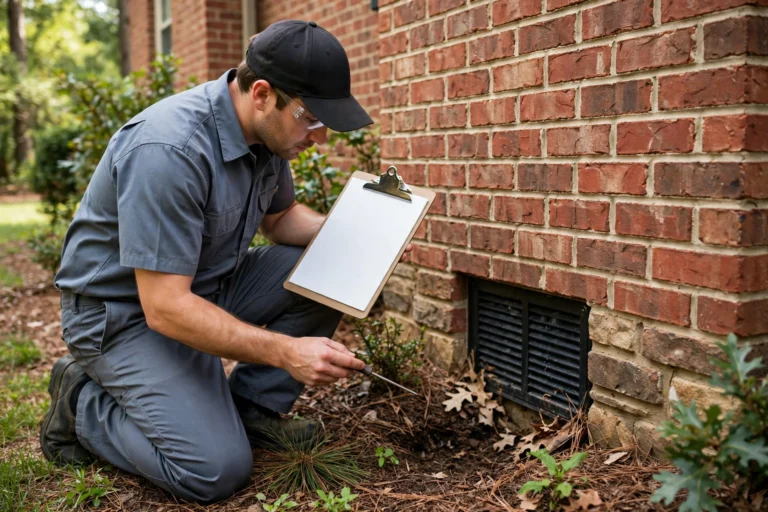
Termite Guide · Hinesville, GA · Drywood Termites & Fumigation
Drywood Termites in Hinesville, GA: Pellets, Kick-Out Holes & When Tenting Is the Answer
A little pile of hard pellets, like coarse sand, keeps reappearing under the same attic rafter or window frame. No mud tubes, no soil, no termites in sight. That is the drywood termite signature, and it is the one termite problem in coastal Georgia where tenting a house can be the right answer. It is also the one most often treated the wrong way, because the soil barrier or bait system that stops subterranean termites does nothing at all to a colony living entirely inside dry wood. Here is how to read the pellets, how to tell drywood from subterranean termites, and when fumigation fits and when it does not.
Key Takeaways
- Drywood termites live entirely inside sound, dry wood. They need no contact with soil, build no mud tubes, and draw the moisture they need from the wood itself. A colony can live in a single rafter, window frame or piece of furniture.
- The pellets are the diagnosis. Hard, six-sided, roughly 1 millimetre pellets, pushed out of tiny kick-out holes, are drywood evidence. Mud tubes mean subterranean termites. Flour-fine powder means powderpost beetles, not termites.
- Colonies are small and slow compared with subterranean colonies, a few hundred to a few thousand termites, and damage builds over years. That slowness is not safety: hidden colonies in attic framing and trim can do serious damage before anyone looks up.
- Soil treatments and bait stations do not reach drywood colonies. Localized treatment fits one accessible colony. Whole-structure fumigation fits widespread or hidden colonies. Fumigation kills everything in the wood and prevents nothing afterwards.
- After fumigation, prevention is the treatment: screened attic vents, borate-treated exposed wood, and checking furniture before it comes inside, or the next swarmers can start again.
What Is a Drywood Termite?
Drywood termites are termites in the family Kalotermitidae that live their whole lives inside sound, dry wood above ground level. The species most often involved along the Georgia coast is the southeastern drywood termite, Incisitermes snyderi, a native species of the southeastern United States found in Florida, Georgia, Alabama, Mississippi and the Carolinas. Unlike the eastern subterranean termite that dominates most Georgia termite work, a drywood colony never touches the ground. A winged pair flies in, sheds its wings, bores into a piece of wood, and starts a colony that stays inside that wood, drawing all the moisture it needs from the timber itself. That is why drywood termites can colonize the upper parts of a house, attic rafters, eaves, fascia boards, window and door frames, trim and furniture, places a soil-dwelling termite reaches only by travelling up through the structure.
A drywood colony is small and slow. University of California IPM puts a mature colony at roughly 2,500 members, and other Extension sources describe colonies of a few hundred to a few thousand, far smaller than a subterranean colony that can number in the hundreds of thousands or, for Formosan termites, in the millions. The colony grows slowly and can take years, four or more in some Extension accounts, before it produces the winged swarmers that start new colonies. The workers, soft, creamy-white, blind termites that do the feeding and tunnelling, are rarely seen, because they stay inside the wood. Soldiers, with enlarged dark, rectangular heads and heavy jaws, guard the colony. The king and queen, the original pair, remain inside the wood for the life of the colony, and supplementary reproductives can develop if the colony needs them.
Swarmers are the part of the colony a homeowner is most likely to see. Southeastern drywood swarmers are about 7/16 inch long including the wings, light yellow to light brown, with clear, uniformly transparent wings, and they swarm at dusk or at night. In coastal Georgia, flights happen on warm, humid, still evenings, most often from late spring through early fall, with the exact weeks shifting year to year with the weather. Texas A&M Extension notes late August and early September flights for this species in Texas, which sits inside that same warm-season window. A swarm itself is brief, often well under an hour, and the swarmers shed their four equal-length wings within minutes of landing, pair up, and search for a crack or crevice in wood to start a new colony. Finding swarmers or a scatter of shed wings inside a home, especially near windows and lights, almost always means a colony is already inside the structure, not that one is about to arrive from outside.
Where drywood termites settle follows the wood, not the soil. Roof framing and rafters, attic woodwork, wall studs and framing inside wall cavities, door and window frames, exterior siding and trim, and wooden furniture are all typical sites. They prefer sound, dry wood, and they can establish a colony in totally non-decayed wood and stay there as long as the wood lasts. Infested furniture is a real route into a home: a colony can arrive inside a vintage dresser, a wooden picture frame or an imported piece, and emerge in the house months or years later. That is why an attic inspection matters in coastal Georgia, and why a furniture check matters before a used wooden piece comes through the door.
What Are the Signs of Drywood Termites?
Look for pellets, kick-out holes and wings, not the termites themselves. Small piles of hard, six-sided pellets under a piece of wood, tiny kick-out holes in the wood surface above the piles, and shed wings on windowsills during swarm season are the signature. No mud tubes. No soil in the galleries. If you find mud, you are looking at subterranean termites, and the treatment is different.
The pellets are the single most reliable sign. Drywood termites are tidy housekeepers: as they tunnel, they push their fecal pellets out of the colony through small kick-out holes in the wood surface, and the pellets collect in little piles on floors, windowsills, furniture or insulation directly below. The pellets are hard, elongated-oval with blunt ends, about 1 millimetre long, with six flattened or concave sides separated by ridges, and their colour matches the wood the termites have been eating, often a salt-and-pepper mix of tan, brown, cream and black. Under a magnifying glass the six-sided shape is unmistakable, and it is what separates drywood pellets from ordinary sawdust, which has no uniform shape at all. Homeowners often mistake the piles for sand, coffee grounds or sawdust at first. The test is the shape and the return: sweep the pile away, and if a fresh pile appears in the same spot days later, the colony above it is active.
The kick-out holes are small, usually less than 2 millimetres across, about the size of a pen tip, and they are often plugged with a pellet of wet feces when not in use, so a hole can look sealed one week and open the next. Other signs follow the same hidden pattern: blistered or bubbled paint where galleries run just below the surface, wood that sounds hollow when tapped, and, if a piece is opened, smooth, clean galleries that cut across the grain of the wood, with no soil or mud inside them. Swarmers and shed wings are the seasonal sign, and because drywood colonies are small, there may be few wings and few swarmers even from an established colony, far fewer than the clouds of wings a subterranean swarm leaves behind. That is one reason drywood infestations go unnoticed for years: the evidence is a teaspoon of pellets, not a mud highway up the foundation.
Where to look is half the inspection. In Hinesville homes, start in the attic: rafters, ridge boards, fascia and eaves, and the tops of wall framing, especially on the sunny side where wood runs warm. Then check window and door frames, trim joints, crown moulding, baseboards and the undersides of wooden furniture, and look on top of insulation and on windowsills for pellet piles and wings. The University of Georgia's entomologist Dan Suiter recommends homeowners inspect once a year during the warmest part of the year, and for drywood termites the advice is to grab the ladder, because many infestations are in the attic and in beams in the upper portions of the home. Photograph any pellet piles with a coin for scale before you clean them, so an inspector can see the pellet shape and the hole size as you found them.
Drywood vs Subterranean Termites: How Do You Tell?
Georgia has both, and the distinction decides the treatment, so it is worth getting right before anyone spends money. Subterranean termites, including the eastern subterranean termite and, in coastal Georgia, the Formosan subterranean termite, live in the soil and travel between soil and wood through mud tubes. Drywood termites live in the wood and never touch the soil. A soil barrier or bait system kills a subterranean colony by intercepting it between soil and wood. It never reaches a drywood colony, because there is nothing travelling between soil and wood to intercept. Treating drywood termites with a subterranean treatment, or subterranean termites with fumigation, wastes the treatment and leaves the colony in place.
| Sign | Drywood termites | Subterranean termites |
|---|---|---|
| Lives | Entirely inside the wood it eats; no soil contact | Colony in the soil; travels into the house through mud tubes |
| Key sign | Hard six-sided pellets under kick-out holes | Pencil-width mud tubes on foundations, piers and walls |
| Galleries | Smooth and clean, cut across the grain, no soil inside | Follow the grain, lined and packed with soil and mud |
| Colony size | Small: a few hundred to a few thousand; roughly 2,500 at maturity (UC IPM) | Large: hundreds of thousands; Formosan colonies in the millions |
| Moisture | Draws moisture from the wood itself; dry wood is enough | Needs soil moisture; dies if cut off from it |
| Damage speed | Slower; builds over years, hidden in upper wood | Faster; large colonies consume wood rapidly |
| Swarmers | Warm humid evenings, late spring through early fall; few wings | Daytime, spring after rain (eastern); evenings May to July (Formosan); many wings |
| Treatment | Spot treatment for one colony; fumigation for widespread or hidden colonies | Liquid soil barrier or bait system; fumigation does not reach the soil colony |
One exception to the mud rule. Formosan subterranean termites can build aerial nests, lined with a carton material of wood pulp, saliva, feces and soil, without soil contact, when a leak keeps the wood wet. An aerial carton nest is not a drywood colony, and it is not treated like one. When the signs are mixed, mud and pellets together, or a nest high in the structure, identification by an inspector, from the specimens, the pellets and the gallery pattern together, is what settles it.
The pellet-versus-mud test also separates drywood termites from the other wood pests that leave debris. Powderpost beetles leave flour-fine powder, not hard pellets, from round exit holes in hardwood, and our powderpost beetle guide walks through that distinction in full. Carpenter ants leave coarse frass mixed with insect parts, and they tunnel to nest, not to eat the wood. Dampwood termites, which need wet, decaying wood, are a different group again and are not the drywood problem in a sound, dry attic. When in doubt, keep the evidence: a small sample of pellets in a sealed bag, a photo of the holes with a coin for scale, and a note of where and when the pile appeared are worth more to an inspector than a description from memory.
If you are finding both signs, do not assume one treatment covers both. A house can hold a subterranean colony in the soil and a drywood colony in the attic at the same time, and each needs its own plan. Our termite control page covers the subterranean side, and our termite swarmers guide helps separate termite swarmers from flying ants, which swarm at the same warm times of year and are often confused with them.
How Do You Read the Pellets?
The pellets repay a close look, because their shape, size, colour and behaviour together identify the pest, and no single feature does it alone. Hold a magnifying glass over a fresh pile. Drywood pellets are hard and dry, elongated with blunt, rounded ends, roughly 1 millimetre long, with six flattened sides separated by ridges, and they feel dry and gritty when rolled between the fingers. Their colour follows the wood: pellets from light pine look pale, pellets from dark hardwood look dark, and a single pile often shows a salt-and-pepper mix. That colour match is itself a clue, because it shows the pellets came from the wood directly above the pile, not from somewhere else in the house.
The pile's behaviour is the activity test. Pellets do not fall once and stop. A drywood colony keeps pushing pellets out through its kick-out holes as it tunnels, so a pile that is swept away and returns in the same spot within days points to a live colony overhead. A pile that never returns, with holes that look weathered and no fresh pellets over a full swarm season, points to old damage, though only an inspection settles it for a report or a sale. Note the hole too: kick-out holes are tiny, under 2 millimetres, and they may be plugged when not in use, so a plugged hole is not proof the colony is gone. And note the count: one pile does not prove one colony. A single colony can use several kick-out holes, and a house can hold several colonies in different pieces of wood, which is exactly why a fumigation decision rests on an inspection of the whole structure, not on one pile.
Do not read pellets as a quantity of damage. A large pile does not mean a large colony, and a small pile does not mean a small problem: pellets accumulate where they fall, and a colony in a rafter can drop pellets onto insulation where nobody looks for years. The pellets tell you the species and the location of one colony. The inspection tells you how many colonies there are, how far the galleries run, and whether the wood is structural. Keep the pellets and the photos for that inspection, and do not vacuum the evidence away before the inspector has seen where it fell.
Is My Infestation Active or Old Damage?
Pellets alone do not prove activity, any more than holes alone prove beetle activity. Pellets are history until they return. The sweep test is the field check: clean the pile away completely, note the date, and check the same spot again over the following days and weeks, during the warm season when termites are active. New pellets in the same spot, new kick-out holes, or swarmers and shed wings inside the home mean the colony is active. No new pellets, no new holes and no swarmers over a full season point to old, inactive damage. But old damage in dry wood deserves a second look before it is dismissed, because drywood colonies are slow and quiet, and a colony that has not yet produced swarmers can still be feeding inside the wood.
Activity also has a location question. Drywood termites enter wood as a winged pair and stay, so a new pile under a window frame may mean a colony that arrived with that frame, or a colony that started in the attic and spread through connected framing. A pile under a piece of furniture may mean the furniture arrived infested, and the house itself may be clear. That distinction matters, because a single infested piece of furniture can be heat-treated, frozen or replaced, while colonies in structural framing need a whole-structure decision. An inspector separates those cases by tapping and probing the wood, checking for hollow sound and gallery patterns, and tracing which pieces of wood show fresh pellets and which show only old holes.
If the wood is structural, sounds hollow, flakes or breaks under a probe, or the pellet piles are appearing in more than one room, do not wait out a season to decide. Get the inspection first, and keep the pellet sample and the hole photos for it. An inspector can confirm the species from the pellets and any specimens, map the extent of the colonies, and document the findings for a wood-destroying-organism report, which is the document a buyer, a lender or a VA loan will ask for.
How Are Drywood Termites Treated?
There is no single drywood treatment, because the extent of the colonies decides what can reach them. A colony in one accessible piece of wood can be treated where it sits. Colonies spread through framing, hidden behind drywall, or in an attic nobody can fully inspect, cannot be reached one hole at a time. The options below are the ones Extension and university guidance actually lists, in order from the most targeted to the most drastic, and the table states the limit of each plainly, because the limit is what decides the choice.
| Option | When it works | Limit |
|---|---|---|
| Remove / replace the wood | One infested piece: furniture, trim, a single board | Not practical for colonies spread through framing |
| Spot injection | One accessible colony, accurately located; foam, dust or liquid injected into galleries | Misses hidden colonies; only treats wood it directly contacts |
| Localized heat | One accessible area; wood heated to at least 120°F for at least 30 minutes, monitored | Large beams and heat sinks are hard to heat through evenly |
| Freezing small items | Furniture and small wood items in a deep freezer at 0°F for several days | Only for items that fit; thicker wood needs longer |
| Borate treatment | Exposed, unfinished wood as prevention; licensed operator applies it | Needs bare wood to penetrate; a preventive coating, not a colony cure on its own |
| Whole-structure fumigation | Widespread or hidden drywood colonies throughout the structure | Kills all stages in the wood, but no residual; reinfestation possible |
| Whole-structure heat | Widespread drywood colonies; an alternative to gas fumigation | Takes hours, needs the whole structure heated evenly; relocation still needed |
Spot treatment is the budget-conscious option when the colony is truly confined. A licensed operator drills small pilot holes into the gallery, injects an expanding foam, dust or liquid termiticide until it backs out of adjacent kick-out holes, and plugs the holes. It works when the colony is accessible and accurately located, and it fails when the colony is not where the operator thinks it is. That is why Extension guidance stresses locating the colony first, from fresh pellets and gallery signs, before drilling anything. Orange oil, d-limonene, is sometimes sold for the same job, but University of California IPM notes that tests have questioned its efficacy, and it should not be presented as a reliable colony cure on its own. Surface sprays do not reach termites inside wood at all.
Replacement is the most direct fix for a single piece. Remove the infested furniture, trim or board, destroy it so the colony does not spread, and replace it with sound, kiln-dried wood. For furniture, heat and freezing are the gentler versions of the same idea: a heat chamber that brings the whole piece to temperature, or a deep freezer at 0°F for several days, depending on thickness, kills all life stages without chemicals. Borate treatments, such as disodium octaborate products applied by a licensed operator to bare, unfinished wood, are best understood as prevention: they coat exposed wood so a new colony cannot easily establish, and they are the treatment to apply during a remodel, when framing is exposed, rather than a rescue for a hidden colony behind drywall.
Fumigation is the treatment for the case spot treatment cannot reach. Texas A&M AgriLife calls tent fumigation the most effective treatment for drywood termites in a building, and University of California IPM notes that whole-structure fumigation with sulfuryl fluoride, especially monitored fumigation where gas lines inside the house track the concentration, has the highest success rate. It is also the most disruptive and the most regulated treatment in this guide, which is why it gets its own section below. The choice between spot treatment and fumigation is an extent question, not a preference question: pellets in three or more rooms, or in load-bearing framing, or in places that cannot be inspected, point toward fumigation, while pellets from a single, clearly located colony point toward spot treatment. A written inspection that maps the colonies is what turns that judgement into a decision.
What Does Fumigation Actually Involve?
Fumigation, in plain terms, is tenting the whole structure and filling it with a gas that penetrates every piece of wood at once. The fumigant used on homes is sulfuryl fluoride, sold as Vikane, a colourless, odourless gas that penetrates deep into wood, walls, beams and attic framing, and kills termites in all life stages, including colonies hidden behind drywall that no spot treatment could reach. Because the gas has no smell, the crew first releases chloropicrin, a strong, tear-inducing warning agent, so that anyone approaching the sealed house knows at once to stay away. Sulfuryl fluoride is a restricted-use pesticide: only certified applicators may use it, and the fumigator must follow the federal label exactly, including the preparation, the gas concentration and exposure time, and the aeration and clearance testing before anyone returns.
- Prepare. Everyone, including pets and houseplants, leaves. Food and medicines are removed or double-bagged in special fumigation bags. Doors, drawers and cabinets are opened so the gas reaches every void. Pilot lights are extinguished and the gas supply is shut off as the label and the utility require. The fumigator gives a written preparation checklist: follow that list, not a general one from the internet.
- Tent and gas. The crew drapes the whole structure in heavy vinyl tarps, seals them to the ground, and introduces a measured dose of sulfuryl fluoride, calculated from the home's cubic footage, the temperature and the target pest. Monitored fumigation, with gas-sampling lines inside the house, tracks the concentration throughout and is the most reliable form.
- Hold and aerate. The gas is held at concentration for the label exposure period, typically 18 to 48 hours within a total job of about 48 to 72 hours, or three days and two nights in the common telling. Then the tent comes off, fans run for at least two hours, and the house stays locked for at least 12 hours from the moment the seal opens, under the Vikane label.
- Clearance testing. Re-entry depends on measured air readings, not on the calendar. The fumigator tests the air in every room with a clearance device, and the house reopens only when readings fall below the EPA limit of 1 part per million. Do not re-enter early, and do not rely on the absence of smell: sulfuryl fluoride itself has none.
Fumigation kills what is in the wood. It does not protect the wood afterwards. Sulfuryl fluoride leaves no residual protection and no surface residue once the house is aerated, so a new drywood colony can start as soon as the gas is gone. It also does not touch a subterranean colony, because that colony lives in the soil outside the tent. Anyone who sells fumigation as a permanent shield, or as a subterranean treatment, is selling the wrong job.
Preparation is where homeowners most often go wrong, and it is the part the fumigator's checklist controls. The common preparation list, from the fumigant label and fumigation companies, runs: remove all people, pets and plants; remove or double-bag all food, medicines, vitamins and pet food in the special bags the fumigator supplies, because ordinary plastic bags do not seal against the gas; open every interior door, drawer and cabinet; extinguish pilot lights and arrange for the gas supply to be shut off and restored; remove or protect heat-sensitive and valuable items the fumigator lists; and arrange to stay elsewhere for the full period, usually two to three nights, until clearance is given. Expect the preparation itself to take two to three hours. If anything on the checklist is unclear, ask the fumigator before the tent goes up, not after.
Safety, stated plainly: fumigation is safe when performed by licensed professionals who follow the label, and it is not a do-it-yourself job under any circumstances. The gas is highly toxic, the warning agent is there precisely because the gas itself cannot be smelled, and re-entry before clearance testing is the danger to avoid. Once the house is aerated and cleared, the National Pesticide Information Center notes that the gas is not expected to leave residue on surfaces. What remains after fumigation is the prevention work in the next section, and a follow-up inspection plan, because the gas that killed the colonies in the wood has no say over the swarmers that arrive next season.
How Do You Prevent Drywood Termites Coming Back?
Prevention after fumigation, or after any drywood treatment, is about closing the routes swarmers use and making exposed wood harder to colonize, because the treatment itself leaves nothing behind to stop the next colony. The swarmers that start new colonies fly in from outside, or from a neighbouring structure, and they look for cracks, crevices and unscreened openings into dry wood. The prevention list below is the one Extension guidance actually gives, and it is shorter than most homeowners expect, because drywood termites do not need soil moisture, so the moisture work that matters so much for subterranean termites and for powderpost beetles does not stop them.
Screen the vents. Soffit and ridge vents should be screened to prevent re-entry of swarmers, and attic vents, eaves and any opening into roof framing should be checked and repaired. Seal cracks and crevices in exterior wood, around window and door frames, and where trim meets siding, because a swarmer pair needs only a small opening to bore into wood and start a colony. Treat exposed wood: disodium octaborate treatment on exposed, unfinished wood, applied by a licensed operator, makes that wood resistant to a new colony, and it is best applied when framing is exposed during a remodel or after fumigation, before the wood is closed back up. Inspect before you bring wood inside: check the undersides and joints of used furniture, wooden picture frames and any salvaged wood for kick-out holes and pellet piles, and do not bring a suspect piece inside without checking it, or heat-treating or freezing it first.
Keep inspecting, on a schedule. Inspect the attic and the upper woodwork once a year, in the warmest part of the year, looking for fresh pellet piles and shed wings, and check after swarm season for new evidence. Keep firewood and scrap wood away from the house, and do not stack infested wood against the structure. And keep the treatment record: if the house was fumigated, note the date, the fumigator and the clearance, and keep the follow-up inspection plan that was agreed in writing. A house that was fumigated and then screened, borate-treated and inspected is a different risk from a house that was fumigated and left exactly as it was, and the next swarm season will tell the difference.
What If Drywood Termites Show Up on a Home Inspection?
Drywood termites are a wood-destroying organism, so they show up on the wood-destroying-organism (WDO) inspection reports used in Georgia home sales, alongside subterranean termites, powderpost beetles and wood-decay fungi, and they matter for VA loans, which require a termite inspection and a clear WDO report in most cases. What matters on a report is not the word drywood, but whether the activity is active, how widespread the colonies are, and whether the wood is structural. Active drywood colonies in attic framing across several rooms are a different negotiation from old pellet piles under a single piece of furniture with no fresh evidence.
If you are buying, ask for the inspector's evidence: pellet shape and freshness, kick-out hole locations, gallery pattern, wood species and locations, and whether fresh pellets returned after a sweep test. Get a written treatment quote that separates the options, spot treatment, fumigation, wood replacement and prevention work, so the numbers reflect the actual job, not the scariest one, and ask whether the quote includes the post-treatment prevention, vent screening and borate treatment, or whether that is extra. If you are selling, the same evidence helps: a clean inspection after treatment and prevention work, with dated photos showing no new pellets, is worth more than a promise that the piles are old. Our VA termite letter page explains the inspection report buyers and lenders ask for, and our termite bonds guide explains the ongoing protection that follows treatment.
Do not paint over kick-out holes or clean away pellet piles before the inspection: the inspector needs the evidence as found, and a fresh coat of paint over active holes hides the signs without stopping the termites inside. Call (912) 205-2930 for a termite inspection in Hinesville before you sign anything. We identify the termite from the pellets, holes and galleries, map how far the colonies run, and tell you in writing whether it is active, whether spot treatment or fumigation fits, and what prevention work should follow.
What Are the Most Common Drywood Termite Mistakes?
- Tenting for mud tubes. Fumigation does not reach a subterranean colony in the soil. Mud tubes need a soil barrier or bait system, not a tent.
- Treating drywood with a soil barrier or bait. The reverse mistake: a colony inside dry wood never travels through the soil, so the barrier and the bait never meet it.
- Spot-treating a widespread infestation. Spot treatment only kills the colony it reaches. Pellets in several rooms, or in framing that cannot be inspected, need a whole-structure decision, not a series of spot jobs.
- Trusting a surface spray or orange oil alone. Surface spray sits on the finish and never reaches termites inside the wood. Orange oil's efficacy has been questioned in UC IPM testing, and it is not a reliable whole-colony cure.
- Fumigating and stopping there. Fumigation kills everything in the wood and prevents nothing. Without vent screening, borate treatment and a furniture check, the next swarmers start again.
- Cleaning the evidence before the inspection. Vacuuming pellet piles and painting over kick-out holes hides the signs an inspector needs to identify the species and map the colonies. Photograph first, clean second.
- Re-entering before clearance. The calendar does not clear a fumigated house. Measured air readings below 1 part per million do. Wait for the fumigator's clearance, every time.
Frequently Asked Questions
Are drywood termites worse than subterranean termites?
Neither is a ranking that helps a homeowner. Subterranean termites cause most of the termite damage in the United States, because their colonies are far larger and they consume wood faster. Drywood termites are slower and their colonies are far smaller, but they are harder to find, because they live entirely inside dry wood in attics and trim, leave no mud tubes, and need no soil contact. A drywood colony left alone for years can still do serious structural damage. The useful question is not which is worse, but which one you have, because the treatments are completely different.
Can I see drywood termites, or only their pellets?
Usually only their evidence. The workers stay inside the wood and are rarely seen. What you see are the pellets pushed out of kick-out holes, the tiny holes themselves, shed wings on windowsills during swarm season, and occasionally the swarmers themselves, flying at dusk on warm, humid evenings. If you break open infested wood, you will see smooth, clean galleries cutting across the grain, with no soil inside. A live termite in the open is the exception, not the rule, which is why pellet shape and freshness carry the identification.
How do I know if drywood termite pellets are fresh and active?
Use the sweep test. Clean the pile away completely, note the date, and check the same spot again over the following days and weeks during the warm season. A fresh pile in the same spot, new kick-out holes, or swarmers and shed wings inside the home mean the colony is active. No new pellets, no new holes and no swarmers over a full season point to old, inactive damage. Pellets alone do not prove how many colonies there are or how far they run, which is why an inspection maps the colonies before any treatment is chosen.
Will tenting kill subterranean termites too?
No. Fumigation kills the drywood colonies living inside the wood of the tented structure. It does not reach a subterranean colony, because that colony lives in the soil outside the tent, and the gas never touches it. A house with mud tubes needs a liquid soil barrier or a bait system, and a house with both mud tubes and pellet piles needs both plans, one for each termite. Anyone who offers fumigation as a subterranean treatment is offering the wrong job.
How long do we have to stay out, and is fumigation safe afterwards?
Plan on two to three days out of the home, commonly three days and two nights, including the exposure period, aeration and clearance testing. Re-entry depends on measured air readings, not on the calendar: the fumigator tests the air in every room, and the house reopens only when readings fall below the EPA limit of 1 part per million. Once the house is aerated and cleared, the gas is not expected to leave residue on surfaces. Fumigation is safe when performed by licensed professionals who follow the label, and it is never a do-it-yourself job.
How much does drywood termite treatment or fumigation cost in Hinesville?
It depends on the extent of the colonies, the size of the structure, and the preparation, and that is why the first step is an inspection and a written quote, not a price. A spot treatment for one accessible colony is the smallest job. Whole-structure fumigation is priced from the home's cubic footage and the fumigation conditions, and published market guides disagree widely on typical figures, which is itself a reason not to trust a single number from the internet. A written quote should separate inspection, treatment, wood replacement and prevention work, and say which parts are included, before work starts.
Do drywood termites come back after fumigation?
They can. Fumigation kills all life stages in the wood, including hidden colonies, but it leaves no residual protection, and a new colony can start as soon as the gas is gone, when the next swarmers fly in and find unscreened vents or an unsealed crack in dry wood. What prevents a return is what happens after fumigation: screened soffit and ridge vents, borate-treated exposed wood, sealed cracks, a furniture check, and a yearly attic inspection. Fumigation without that prevention work is a reset, not a fix.
Can drywood termites infest furniture, and should I throw infested furniture away?
Yes, they can, and no, throwing it away is not the only option. A colony can arrive inside a piece of wooden furniture and live there for years. Check the undersides, joints and any kick-out holes and pellet piles before deciding. A single infested piece can often be heat-treated in a chamber, frozen in a deep freezer at 0 degrees Fahrenheit for several days, or, if the damage is extensive, replaced. Do not bring a suspect piece inside, and do not stack infested wood against the house. An inspector can confirm whether the furniture is the only colony, or whether the house framing holds colonies too.
The Bottom Line
Drywood termites announce themselves with two things: hard, six-sided pellets and tiny kick-out holes, with no mud and no soil in sight. The pellets tell you the species, the sweep test tells you whether the colony is active, and the inspection tells you how far the colonies run. One accessible colony can be spot-treated. Widespread or hidden colonies need fumigation, with its two to three days out, its preparation checklist and its clearance testing, and fumigation needs prevention afterwards, or the next swarmers will start again. Either way, do not treat drywood termites with a subterranean treatment, and do not treat subterranean termites with a tent. Identify first, from the pellets and the galleries, and the right treatment follows.
Sources
Pellets Under the Trim? Wings on the Windowsill?
Species identified first · Colonies mapped · Written price before work
About Us
Hinesville Pest Control is a local, Hinesville-only service for termites, cockroaches, mosquitoes, ants, rodents and bed bugs. We know how coastal Georgia storms, humidity and PCS moves bring pests inside. Our promise is simple: written prices, licensed technicians, and homes that stay pest-free.
Our Address
🏢 Hinesville Pest Control
938 Elma G Miles Pkwy
Hinesville, GA 31313
Areas We Serve
Serving Hinesville & Liberty County
- Hinesville
- Fort Stewart
- Richmond Hill
- Midway
- Walthourville
- Allenhurst
- Flemington
- Ludowici
- Riceboro
- Gum Branch