
Rodent Guide · Hinesville, GA · Rats & Mice in Cars
Rodents in Your Car in Hinesville, GA: Chewed Wires, Nests & Getting Them Out
The check-engine light comes on for no clear reason, or the air conditioning smells musty the first time you run it, or you lift the hood and find shredded insulation tucked beside the battery. In Hinesville, a car that sits for a few days in a driveway, a garage or a storage lot is not just parked. To a rat or a mouse it is a warm, dry, sheltered box with soft nesting material and wiring to gnaw, and in coastal Georgia that box is available all year. This guide covers how rodents get in, how to tell whether the damage is active, how to clean a nest out safely, and how to stop the same car being chosen again, starting with the step most people skip: do not just start the engine and drive away.
Key Takeaways
- A parked car is shelter, warmth and nesting material in one package. Engine heat after a drive, hood insulation, seat foam, cabin-filter housing and quiet, undisturbed days are what draw rodents in, and a car left sitting is far more likely to be nested in than a car driven daily.
- Rodents gnaw because their incisor teeth grow continuously, not only because they are hungry. Wiring insulation, hoses, foam and plastic are all chewing targets, so chewed wires do not prove any one material in the car attracted them.
- Do not start a car that has sat with signs of rodents until you have looked under the hood. Chewed wiring, a blocked air intake or nesting material near hot or moving parts can turn a small nest into an electrical fault, a failed sensor or a fire risk.
- Clean droppings and nests wet, never dry. The CDC vehicle guidance is to air the car out, soak contaminated material with disinfectant, wait, and pick it up with paper towels. Sweeping, vacuuming or pressure-washing dry droppings first can stir contaminated dust into the air.
- No scent, sound or spray finishes the job on its own. The lasting fix is the source around the car: the garage and parking area sealed and cleared, food and nesting material removed, the car moved and checked often, and vulnerable wiring protected after a mechanic has repaired it.
Why Do Rodents Choose a Parked Car?
A car answers the three things a rodent looks for, without the rodent having to cross open ground for long. It is enclosed and dark, which means shelter from predators and weather. It holds heat after a drive, which matters on a cool night and matters even more in the fall and winter, when the University of Georgia Extension notes rodents move toward heated structures. And it is full of soft material that can be shredded into a nest: hood insulation, sound-deadening foam, seat padding, carpet backing, cabin-filter paper and the paper, leaves and fabric a rodent carries in from outside. Add a few days without the car moving, and the engine bay becomes a territory rather than a hiding place.
In Hinesville the pattern is year-round, with a seasonal peak. Coastal Georgia winters are mild, so rodents do not shut down the way they do farther north, and they stay active through the cooler months. Fall still brings the sharpest rise in shelter-seeking, as nights cool and outdoor food and cover thin out, and that is when a car parked under trees, beside a brush pile or in a cluttered garage is most likely to be tried. The other high-risk pattern is local and specific to a military town: a car left standing during a deployment, a training rotation, a long trip or a PCS move. Fort Stewart families know this one well. A vehicle that does not move for weeks gives a rodent time to build, breed and chew without a single disturbance, and the first sign is often discovered on the drive home, not in the driveway.
How a rodent gets in is less mysterious than it looks. A house mouse can fit through an opening about a quarter of an inch wide, and a University of Georgia specialist puts the working figure for mice and rats entering a house at openings as small as a dime. A car is not sealed the way a house is meant to be. Entry routes include the engine compartment itself, wheel wells, gaps around steering and wiring pass-throughs in the firewall, cabin air intakes and vents, and the trunk and cabin through damaged seals, open windows left cracked, or a sunroof drain. Once under the hood, a rodent can reach the cabin air-filter housing and the ducting that leads straight into the passenger compartment, which is how a nest under the hood becomes a smell through the vents and droppings in the glove box. There is no need to find a single perfect hole. The practical question is not how this one rodent got in, but how many quiet, food-rich, undisturbed hours the car and its parking spot are offering.
Food is the part owners control most, and it is usually the part they underestimate. Crumbs in a child seat, a fast-food bag forgotten overnight, pet food in a garage bin, birdseed stored beside the car, a water bottle leaking in the trunk, and even the salt and food smells on floor mats all raise the value of the car as a territory. None of it has to be a meal. Rodents explore by smell, and a car that smells of food, that sits beside a bird feeder or a pet-food bin, and that never moves will be investigated sooner than a clean car parked in the open and driven every day. That is also why two cars in the same driveway can have very different luck: the one with the crumbs, the clutter around it and the longer sits is the one that gets nested in.
What Are the Signs of Rodents in a Car?
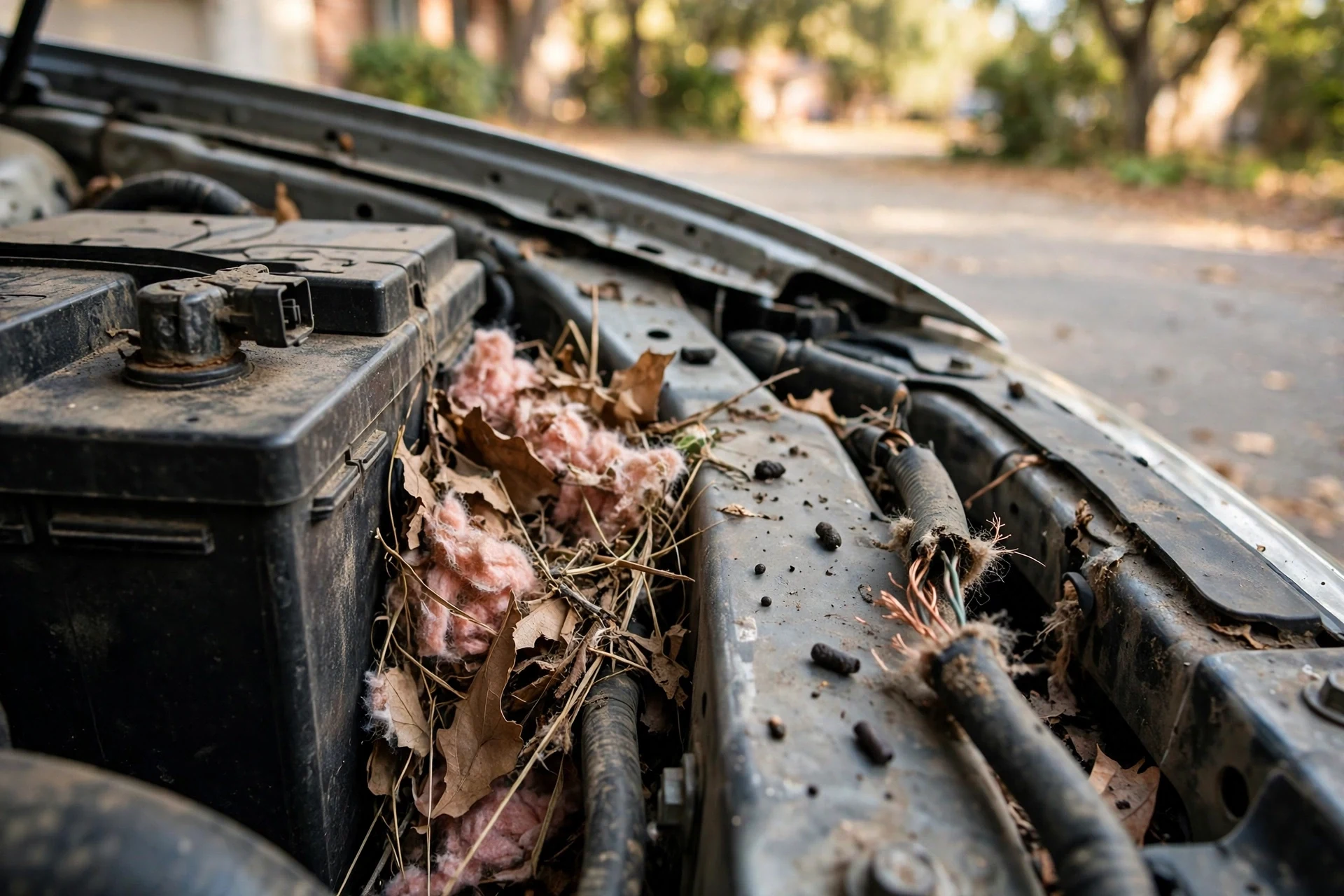
Look under the hood before you look at the dashboard. Droppings and shredded nesting material in the engine bay, chewed insulation on a wiring harness, and a nest in the cabin air-filter housing are the early signs. A warning light, a dead sensor or a strange smell through the vents is often the late sign, discovered after the chewing has already happened.
Start with the engine bay, with the engine off and cool. Look between the battery and the frame, near the wiper motor, under and around the air-intake ducting, inside the air-filter box, and along wiring harnesses and hoses. The signs to look for are small, dark, rice-shaped droppings; shredded paper, fabric, foam, leaves or insulation gathered into a loose nest; gnaw marks and frayed or missing insulation on wires, with copper showing; chewed hoses, vacuum lines and plastic clips; and a strong, musky urine smell. A nest is often tucked where it is hard to see at a glance, so a flashlight and a slow look along the firewall and the inner fenders matter more than a quick glance at the top of the engine.
Inside the car, the signs are quieter and easier to miss. Check under and behind the seats, in the footwells, in the glove box and centre console, in the trunk and spare-tyre well, and around the cabin air filter, which in many cars sits behind the glove box. Droppings near the pedals or under a seat, shredded seat foam or headliner material, chewed seat belts or upholstery, nesting material in a door pocket, and a musty or urine smell when the fan or air conditioning runs all point the same way. A cabin filter that comes out torn, soiled or packed with leaves and insulation has almost certainly been nested on, and it should be replaced rather than shaken out and put back.
The car itself will often tell you before you open the hood. A check-engine light, a warning for a sensor that was fine last week, flickering lights, a fan or blower that sounds obstructed, a heater or air conditioner that blows weakly or smells stale, a car that cranks but will not start, or a new smell of hot insulation after a short drive can all follow chewed wiring or a blocked intake. None of these proves rodents on its own, which is why the inspection matters: a mechanic who finds droppings, nesting material and gnawed insulation alongside the fault has the cause, while a warning light alone could be a dozen other things. Photograph what you find before you clean it. Dated photos of droppings, nests and chewed wiring are useful for a mechanic, for a pest inspection, and for an insurance conversation later, and they cost nothing to take.
Freshness separates an active problem from an old one. Fresh droppings are dark and soft-looking, fresh gnaw marks show pale, clean material underneath, and a nest that is rebuilt within days of being removed means the rodent is still using the car. Old droppings turn grey and crumbly, old nests look dusty and compressed, and a spot that stays clean for a week or more after a thorough clean, with no new droppings, suggests the visitor has moved on. The test is the same one used in a house: clean properly, then check the same places again over the following days. A car that keeps producing new droppings after a clean still has a source nearby, and that source, usually the garage, the parking area or a neighbouring structure, is what needs fixing next.
Which Rodent Is in the Car?
In Georgia, three commensal rodents do most of the indoor damage, and all three can be found in the state, according to University of Georgia Extension: the house mouse, the Norway rat and the roof rat. A fourth, the deer mouse, is more a rural and wooded-edge animal in Georgia and matters most for the health precautions in the cleaning section, because deer mice are the rodents most associated with hantavirus. You will rarely see the animal itself, so identification usually comes from size, droppings, behaviour and where the signs are, and it is often an informed guess rather than a certainty. That uncertainty is fine. The cleaning precautions and the exclusion work are the same for all of them, and a pest professional identifies the species from the full pattern, not from one dropping.
| Rodent | Size and look | Where it nests | Car clue |
|---|---|---|---|
| House mouse | About 3 inches long, not counting the tail; small, grey-brown, pointed muzzle | Close to food and cover; stays within a few feet of its nest when well fed | Smallest droppings, about a grain of rice; fits the tightest gaps, including a quarter-inch opening |
| Roof rat | Sleek, 5 to 10 ounces; ears extend past the eyes; long tail used for balance | Above ground: attics, eaves, trees, upper framing; an excellent climber | The classic Hinesville attic and engine-bay climber; reaches a car from trees, vines and utility lines |
| Norway rat | Heavy-bodied, over a pound; ears do not reach past the eyes; not a strong climber | Ground level: burrows, basements, ground-floor voids | More likely where a car sits beside burrows, clutter and ground-level harbourage |
| Deer mouse | White belly, large eyes and ears; more a field and woodland mouse | Outbuildings, sheds, vehicles and cabins at the rural edge | Assume the CDC cleaning precautions regardless; do not rely on guessing the species from droppings |
In Hinesville, the roof rat deserves a special mention. It is a climbing rat, it nests above ground, and it travels along tree branches, vines, fences and utility lines to reach attics, eaves and, from there, a car parked close to the house or under a tree. A car parked under a low oak limb, beside a dense shrub or against a garage with a vine-covered wall is within easy reach of a roof rat that never has to cross open ground. House mice, by contrast, are the small-gap specialists. They need almost nothing to get in, they stay close to a food source once they find one, and they are the most likely culprit for a nest inside the cabin itself, behind a glove box or under a seat. Squirrels can also chew car wiring and nest in an engine bay, and their damage can look similar at a glance, but the prevention in this guide, removing the source, protecting the wiring after repair, and checking often, applies to them too, and a professional inspection separates a squirrel nest from a rat nest by the material, the droppings and the entry route.
Do not try to settle the species question by handling droppings or a dead rodent with bare hands, and do not assume a small dropping means a small problem. A single house mouse can produce dozens of droppings a day, and a rat nest in an engine bay can be built in a night or two. If you find a live rodent in the car, do not corner it, do not try to grab it, and do not start the car with it loose in the cabin. Open the doors in an open area, step back, and let it leave on its own, then inspect and clean before driving. A trapped, frightened rat will bite, and a rodent loose behind a dashboard is a distraction and a chewing risk at the same time.
What Damage Can Rodents Do to a Car?
The expensive damage is usually electrical, and it is expensive because a modern car is wired through almost everything. Rodents chew wiring harnesses, sensor wires, injector wiring, ignition wiring, lighting circuits and the wiring for safety systems, and a single severed wire can disable a sensor, trigger a warning light or stop a car starting. Replacing a harness is labour-heavy work: the part may be routed through the engine bay and the firewall, and a mechanic may have to remove other components to reach it. That is why a repair bill for chewed wiring can run into the hundreds for a small repair and into the thousands when a whole harness, a sensor set or a control unit is involved. Treat any single number you read online as an example, not a quote. The only number that matters is the written estimate for your car, after a mechanic has seen the damage.
Beyond wiring, rodents chew hoses and vacuum lines, which can cause coolant or vacuum leaks, and they damage insulation, foam, upholstery, seat belts and plastic trim. Nesting material in the air intake or the cabin-filter housing restricts airflow, strains the blower and pushes a stale, musty smell through the vents. Nesting material near the exhaust manifold, the engine or other hot parts is a fire risk, and chewed wiring that shorts can be one too, which is another reason not to start a car with a known nest and chewed wires until it has been inspected. A nest in the ventilation system is also a health matter, not just a comfort one: droppings, urine and nesting material in ducting can be blown into the cabin, and the cleaning section below covers how the CDC guidance handles that.
There is a second kind of damage that shows up later. A car that has been nested in once, cleaned only on the surface, and parked in the same spot will often be nested in again, because the scent trails, the food smells and the harbourage around the parking spot have not changed. Each return visit adds new gnawing, and a harness that survived one visit with a nick in the insulation may fail on the next. That is why the repair and the prevention belong together: fix the wiring, protect the repaired wiring where a mechanic advises it, and change the conditions around the car in the same week, not the same season.
Is Soy-Based Wiring the Reason?
You will read, confidently and often, that rodents chew car wires because modern wiring insulation is made with soy, and that the soy smells like food. The honest version is narrower. Some vehicles do use plant-derived materials in some plastics, coatings, foams and wiring-related components, and that varies by automaker, supplier, model, component and production year. Rodents also chew conventional petroleum-based wire insulation, rubber hoses, plastic, foam and upholstery, and they have chewed wiring in homes and cars for far longer than any plant-derived insulation has existed. Their teeth grow continuously, and gnawing is how they wear them down. A car engine bay offers shelter, warmth, nesting space and soft material to gnaw, with or without any particular insulation recipe.
Soy may be part of the story in some cars, but it is not the whole story, and it is not a diagnosis. Chewed wires do not prove the insulation attracted the rodent, and unchewed wires do not prove a car is safe. The useful conclusion is the same either way: reduce access, remove the reasons to stay, and protect vulnerable wiring after a repair, rather than waiting for a different insulation material to solve the problem.
The practical consequence matters. If soy were the whole cause, the fix would be to buy a different car or wait for a manufacturer change, and neither helps the car in the driveway this week. The fix that does help is the one in this guide: clean the car and its parking area, seal the garage, move and check the car often, trap and remove the rodents using the garage and the yard, and ask a mechanic about protecting repaired harnesses with rodent-deterrent tape or conduit. Honda sells a capsaicin-infused rodent-deterrent tape, part number 4019-2317, that is wrapped around wiring after a repair, and similar capsaicin-treated tapes exist from other suppliers. It protects only the wiring it covers, it is not a force field for the whole car, and it makes sense as one layer after a repair, not as a substitute for removing the rodents and sealing the garage. A mechanic should advise whether it fits your car and where it should go, because tape over damaged, unrepaired wiring hides the fault instead of fixing it.
Be careful with the other version of this story, the one that says only certain brands are affected. Rodent wiring damage is reported across many makes and models, in petrol, diesel, hybrid and electric vehicles, and electric and hybrid cars can be at least as attractive, because they contain more wiring and can hold low-level heat even when powered off. No brand is a guarantee, and no brand is a lost cause. Check the car you have, on the schedule in this guide, and judge the risk by the parking spot and the sits, not by the badge.
What Should You Do First?
If you find droppings, a nest or chewed wiring, treat the car as a safety check first and a cleaning job second. Do not start the engine, do not run the fan or the air conditioning, and do not drive to the shop with a nest in the engine bay if you can avoid it. Starting the engine can draw nesting material and contaminated dust through the ventilation system, can spin a fan into a nest, and can short chewed wiring. If the car must be moved, and it is safe to do so after a visual check for obvious damage, move it a short distance in an open area, or have it towed. When in doubt, call a mechanic and describe what you found, with photos, before you turn the key.
- Look, do not start. With the engine off and cool, open the hood and look for nests, droppings and chewed wires, hoses and insulation. Check the cabin air filter and the trunk. Photograph everything before you touch it.
- Air it out. Move the car to an open, well-ventilated space if you safely can, open the hood, doors and trunk, and leave it to air out for 20 minutes, following the CDC vehicle guidance. Do not sit in the car during that time.
- Call the right two people. A mechanic for the wiring, hoses, filters and ventilation system, and a pest professional for the rodents using the garage, yard and parking area. One without the other leaves half the problem in place.
- Clean wet, then check again. Follow the CDC cleaning steps in the next section, replace the cabin air filter, and then check the same places daily for a week. New droppings mean the source is still active.
If the car shows warning lights, will not start, smells of hot insulation, or has a nest near hot or moving parts, skip the home inspection and get professional help. The same applies if the infestation is heavy, with piled droppings, several nests or dead rodents, or if rodents are in the ventilation ducts. The CDC guidance recommends a professional for extensive vehicle infestations and for rodents in ventilation systems, and that is the right call for a car as well as for a house. A heavy infestation is not a bigger version of a light one. It needs respiratory protection, a proper clean of the ducting, and a mechanic's inspection of everything the rodents could have reached.
How Do You Clean a Nest Out Safely?
Rodent droppings, urine and nesting material can carry disease, and the risk comes from breathing in dust stirred up when dry material is disturbed. In the United States the best-known example is hantavirus, carried by some wild rodents, notably deer mice, which can cause a rare but serious lung illness. House mice, roof rats and Norway rats are not the usual hantavirus carriers, but you cannot reliably identify a species from droppings alone, and the cleaning precautions are the same regardless. The CDC guidance for a rodent-infested vehicle is built around one principle: keep the material wet, keep the dust down, and do not turn a localised nest into airborne dust.
Before you start, put on disposable plastic or rubber gloves and a long-sleeved shirt, and work outdoors or in a well-ventilated space. For a heavy infestation, wear a properly fitted N95 respirator, eye protection and coveralls, and consider a professional instead. Air the vehicle out first: open the hood, doors and trunk and leave it for 20 minutes. Do not start the vehicle. If you are going to work in the engine compartment, disconnect the battery cables first to reduce the risk of a shock while you clean around wiring, and follow the vehicle manufacturer's safety guidance. For a hybrid or electric vehicle, do not work around high-voltage components yourself. Leave that to a qualified mechanic.
- Soak, do not sweep. Spray droppings, urine-stained areas and nesting material until fully soaked with a commercially labelled disinfectant, or with a mixture of 1 part household bleach to 9 parts water, made fresh. Let it sit for 5 minutes, or for the time on the disinfectant label. Do not use a vacuum cleaner, a broom, pressurised air or a pressure washer on dry droppings or nests before they have been soaked.
- Pick up with paper towels. Wearing gloves, pick up the soaked material with paper towels, place it in a sealed bag, and put the bag in the garbage. Do not mix bleach with ammonia or other cleaners.
- Clean the area again. After the droppings and nesting material are removed, clean the rest of the affected area with additional disinfectant, and let it dry. Replace the cabin air filter. If rodents were in the air ducts, hoses or fan housing, have a mechanic inspect, disinfect and, where needed, replace those parts. Do not just spray air freshener into the vents.
- Finish with your hands and gloves. Wash gloved hands with disinfectant or soap and water, remove the gloves, and wash your bare hands thoroughly with soap and warm water. Launder clothing that was in contact with contaminated material, and disinfect tools and surfaces you used.
Two cautions belong here plainly. First, do not use mothballs in or around a car. Mothballs are not labelled for repelling rodents, their fumes are toxic, and in a car those fumes are drawn straight into the cabin through the ventilation system. Second, do not rely on a smell to tell you the car is clean. A car can smell fine and still hold contaminated dust in ducting and under trim, which is why the filter is replaced, the ducting is inspected when rodents were in it, and the same places are checked again over the following days. If anyone in the household develops a fever, muscle aches or breathing difficulty after cleaning a heavily infested vehicle, seek medical advice promptly and mention the rodent exposure.
How Do You Get Rodents Out and Keep Them Out?
Getting a rodent out of a car is the short part. Keeping the car from being chosen again is the work, and it happens mostly outside the car. A rodent in a car is almost always a symptom of rodents using the garage, the yard or a neighbouring structure, and a car that is cleaned and then parked in the same conditions will be recolonised. The sequence that lasts is: remove the rodents that are using the area, seal the garage and the parking area, remove food and harbourage, and then protect the car itself.
Trapping is the reliable removal method around a car and a garage. Snap traps, set along walls and runways where droppings and gnaw marks show activity, catch the animal, let you count the catch, and leave no toxic bait to be carried into a wall cavity or a car duct. Set traps in the garage and around the parking area, not loose inside the car cabin, where a trap can slide under a pedal or into ducting, and check them daily. Keep traps out of reach of children and pets, and wear gloves when handling a trap and a dead rodent. Do not use rodent poison in or around a car. Poison takes days to work, a poisoned rodent can die inside a wall, a duct or the car itself, and poisoned rodents and bait are a risk to pets, children and wildlife. Glue traps are not recommended: they are inhumane, they catch non-target animals, and a live rodent stuck to a glue trap in a hot car is a welfare and a hygiene problem at once.
The garage is usually the source, and it is where exclusion pays. Seal gaps under and around garage doors, around conduit and pipe penetrations, at vents and at the junction of walls and roof, with durable materials, metal mesh, sheet metal, concrete or heavy-gauge hardware cloth, rather than foam or plastic that a rodent can gnaw through. A mouse needs only a quarter-inch gap, so the test is a pencil: if a pencil fits, a mouse can try. Remove clutter, cardboard, stored seed and pet food from the garage, keep garbage in sealed containers, trim trees and vines back from the roof and the garage, and keep firewood, brush and debris away from the building. Our rodent proofing and exclusion page covers the house side of this work, and our fall rodent-proofing checklist is a useful seasonal pass through the same gaps. If the garage already has an active infestation, trapping and exclusion need to happen together: sealing a garage with rodents still inside traps them in with the car.
Call (912) 205-2930 for a rodent inspection in Hinesville if droppings keep appearing after a clean, if you hear scratching in the garage or the attic at night, or if the car has been nested in more than once. We identify the species from the droppings, gnaw marks and entry routes, trap and remove the rodents using the property, seal the gaps they are using, and tell you in writing what was found and what was sealed. The car itself still needs a mechanic for wiring and ducting, and we will say so plainly when that is the case, because a pest treatment does not repair a chewed harness.
How Do You Prevent Rodents in a Car That Sits?
Prevention for a car that sits is a routine, not a product. The cars that get nested in are the ones that sit longest, in the most sheltered spot, with the most food smells and the least checking. Change those four things, and the risk falls sharply, even in a neighbourhood with roof rats in the trees. The checklist below is written for a car parked at home in Hinesville, and the storage notes at the end cover the longer sits, deployments and PCS moves.
- Drive it and check it. Drive the car at least once a week, and lift the hood for a two-minute check every time it has sat for more than a few days. Look for droppings, nesting material and chewed insulation. Moving the car breaks the quiet that nesting needs, and a weekly check catches a nest at the one-night stage, before it becomes a harness repair.
- Take the food out. Remove crumbs, wrappers, groceries, pet treats and drinks from the cabin and the trunk, vacuum the footwells and seats, and do not store pet food, birdseed or grass seed in the garage beside the car. Keep garage garbage sealed and the area around the parking spot clear of leaves, cardboard and clutter.
- Park in the open where you can. Park away from dense shrubs, brush piles, woodpiles and low tree limbs where you have a choice, and keep the ground around the parking spot visible, so fresh droppings and tracks are easy to see. Trim branches and vines back from the garage roof and from above the parking spot.
- Seal the garage, not the car. Seal the garage gaps described above, keep the garage door closed, and do not block cabin air intakes, vents or drains yourself. Any mesh or guard over an intake or a vent is a mechanic's job, because a blocked intake can overheat a system or starve it of air. Do not tape over vents or stuff steel wool into a car opening.
- Protect repaired wiring. After a mechanic has repaired chewed wiring, ask about rodent-deterrent tape or protective conduit on the repaired and vulnerable harnesses. Tape protects only what it covers, and it is a layer after repair, not a repair itself.
- Treat scents and sounds as extras, not as the plan. Peppermint oil and ultrasonic devices are the two products most often sold for this job, and the evidence for both is weak. University of California IPM finds little evidence that sound devices drive established mice out of buildings, and NC State Extension calls repellents, including peppermint oil, not a reliable form of mouse management or prevention, noting that highly volatile oils disappear quickly. A scent that fades in days, in a hot engine bay, is not a plan. If you use one, use it alongside trapping, sealing and checking, and judge it by whether new droppings appear, not by whether the car smells of peppermint.
For a longer sit, a deployment, a PCS move or a car stored for a season, arrange for someone to drive and check the car weekly, or store it where that checking happens. Before a long sit, clean the car thoroughly inside and out, remove all food and scented items, fill the fuel tank if the owner's manual advises it for storage, and tell the person checking it what to look for: droppings, nests, chewed insulation and a cabin filter that smells stale. A car cover can discourage access when it is weighted and seals around the vehicle, according to UC IPM, but a cover over a dirty car in a cluttered garage is a tent over a nest, not a barrier. The checking routine matters more than the cover. When the car returns to daily use, do the full under-hood and cabin check in the first section before the first long drive, even if nothing looks wrong from the outside.
Will Insurance or a Warranty Pay for Rodent Damage?
Rodent damage to a car is usually an insurance question, not a warranty question, and the answer depends on the policy you actually hold. Manufacturer and extended warranties generally cover defects in materials and workmanship, not damage caused by an animal, and rodent chewing is commonly excluded as environmental or animal damage. Auto insurance is different: damage caused by an animal, including rodents chewing wiring, hoses and insulation, is the kind of non-collision loss that comprehensive coverage is designed for, and several insurers describe rodent damage as typically falling under comprehensive coverage. Liability-only and collision-only policies do not cover damage to your own car from rodents.
Comprehensive coverage does not mean every claim is paid in full. Your deductible applies first, so a repair that costs close to your deductible may not be worth claiming. The insurer will want documentation, and the mechanic's wording matters: a written report that records rodent activity, droppings, nesting material and gnawed wiring, with dated photos, supports a claim far better than a report that says only that a wire failed. Damage that looks like long-term neglect, a known infestation left unaddressed until it became severe, or damage that existed before the policy started, is harder to claim. If you find rodent damage, photograph it before cleaning, get a written mechanic's estimate that separates the rodent damage from any unrelated wear, and check your policy and deductible before you file. Call (912) 205-2930 if you need a written pest-inspection record to go with the mechanic's report. We document the species signs, the entry routes and the exclusion work, which is the part of the file a mechanic cannot write.
What Are the Most Common Rodents in Car Mistakes?
- Starting the car first. Turning the key with a nest in the engine bay can short chewed wiring, spin a fan into nesting material, and draw contaminated dust through the vents. Look first, then decide whether to move it or tow it.
- Dry-cleaning the droppings. Sweeping, vacuuming or pressure-washing dry droppings and nests stirs dust into the air. Soak with disinfectant first, wait, then pick the material up wet with paper towels.
- Poison in or around the car. A poisoned rodent can die inside a duct, a wall or the car, and poison is a risk to pets, children and wildlife. Trap around the car and in the garage, and fix the source.
- Mothballs in the cabin or under the hood. Not labelled for rodents, toxic fumes, and in a car those fumes go straight into the ventilation system. Do not use them.
- Trusting a scent or a sound alone. Peppermint oil fades in days in a hot engine bay, and ultrasonic devices have little evidence behind them for established rodents. They are extras, not exclusion, trapping and checking.
- Sealing the car, not the garage. Blocking a vent or stuffing an opening in the car can overheat a system or hide the entry route. Seal the garage and the parking area, and leave car openings to a mechanic.
- Cleaning the car and parking it in the same spot unchanged. The same shelter, food smells and harbourage will bring the next rodent. Change the parking area and the routine in the same week as the clean.
Frequently Asked Questions
How do I know if rodents are in my car, or if the problem is something else?
Look for the pattern, not a single sign. Droppings plus shredded nesting material plus gnaw marks on wiring or insulation, in the engine bay, the cabin-filter housing or under a seat, is a rodent pattern. A warning light on its own could be many things, and a smell on its own could be a blocked drain or a mouldy filter. Photograph the droppings, the nest and any chewed wiring before you clean, and have a mechanic confirm the cause alongside the fault. If the same places produce fresh droppings within days of a proper clean, the rodents are still active.
Can rodents chew through car wiring in one night?
They can do real damage in a single night, and a nest can be built in a night or two, but a severed harness is usually the result of repeated visits rather than one bite. Rodents gnaw constantly to wear down teeth that grow continuously, and they return to a quiet, undisturbed car. That is why a car that sat for a weekend can show a nest, while a car that sat for a month can show a failed sensor and a harness that needs replacing. Check a car that has sat for more than a few days before you rely on it for a long drive.
Does soy-based wiring attract rodents to my car?
Not as a proven, sole cause. Some vehicles use plant-derived materials in some components, and that varies by automaker, model and year, but rodents also chew conventional petroleum-based insulation, rubber, foam and plastic, and they have chewed wiring for far longer than plant-derived insulation has existed. Chewed wires do not prove the insulation attracted them. The fix is the same either way: remove the rodents using the garage and parking area, seal the garage, check the car often, and protect repaired wiring where a mechanic advises it.
How do I safely clean mouse droppings and a nest out of my car?
Follow the CDC vehicle guidance: air the car out for 20 minutes with the hood, doors and trunk open, wear gloves and a long-sleeved shirt, and disconnect the battery before working in the engine compartment. Soak droppings and nesting material with a labelled disinfectant or a fresh 1 part bleach to 9 parts water mixture, wait 5 minutes, and pick the material up with paper towels into a sealed bag. Do not sweep, vacuum or pressure-wash dry droppings first. Replace the cabin air filter, and have a mechanic inspect the ducting if rodents were in it. For a heavy infestation, wear a fitted N95 respirator or call a professional.
Will peppermint oil or an ultrasonic device keep rodents out of my car?
Do not rely on either one alone. University of California IPM finds little evidence that sound devices drive established mice out of buildings, and NC State Extension calls repellents, including peppermint oil, not a reliable form of mouse management or prevention, noting that highly volatile oils disappear quickly. In a hot engine bay a scent fades in days. Judge any deterrent by whether new droppings appear, and pair it with trapping, garage sealing, food removal and weekly checks, which are the measures with evidence behind them.
Should I use poison or mothballs to get rodents out of my car?
No to both, for different reasons. Poison takes days to work, a poisoned rodent can die inside a duct, a wall or the car itself, and poisoned rodents and bait are a risk to pets, children and wildlife. Mothballs are not labelled for repelling rodents, their fumes are toxic, and in a car those fumes are drawn into the cabin through the ventilation system. Use snap traps in the garage and around the parking area, not loose inside the cabin, fix the garage gaps, and remove the food and harbourage that brought the rodents in.
Does car insurance cover rodents chewing car wires?
Often, if you carry comprehensive coverage, which is the part of an auto policy that covers non-collision losses including animal damage. Liability-only and collision-only policies do not cover damage to your own car from rodents, and manufacturer warranties generally exclude animal damage. Your deductible applies, so compare the written repair estimate with your deductible before filing, and keep dated photos and a mechanic's written report recording rodent activity, droppings, nesting material and gnawed wiring. Damage left unaddressed as a known infestation, or damage that predates the policy, is harder to claim.
Will rodents come back to my car after I clean it?
They will if the car and its parking spot have not changed. A clean car parked in the same cluttered garage, beside the same birdseed and pet food, under the same tree limb, and left sitting for the same long stretches is the same opportunity with a fresh smell. They are much less likely to return if the garage is sealed, food and clutter are removed, the car is driven and checked weekly, and repaired wiring is protected. Check the same under-hood and cabin places daily for a week after a clean. No new droppings in a week, with the source work done, is a good sign the visit is over.
The Bottom Line
A car is not rodent-proof, and in Hinesville it does not need to be parked for a season to be tried. It needs to sit quietly, in a sheltered spot, with food smells and soft material close by, for a rat or a mouse to move in and start chewing. The order that works is the order in this guide: look before you start the engine, clean wet following the CDC steps, get a mechanic to check the wiring and the ventilation, and fix the garage and the parking area that supplied the rodents in the first place. Do that, drive and check the car weekly, and a nest becomes a one-night story instead of a harness repair. Leave the source in place, and the next rodent will find the same warm box waiting.
Sources
- Centers for Disease Control and Prevention: How to Clean Up After Rodents — How to Inspect and Disinfect a Vehicle
- University of Georgia CAES Field Report: Ban Winter Rodents From Your Home (Mengak, Warnell School of Forestry & Natural Resources)
- University of California Statewide IPM Program: House Mouse — exclusion, trapping and sound devices
- NC State Extension: Surveillance and Management of Common Structure-Invading Mice — repellents
Nest Under the Hood? Warning Light After a Sit?
Inspection first · Source sealed · Written price before work
About Us
Hinesville Pest Control is a local, Hinesville-only service for termites, cockroaches, mosquitoes, ants, rodents and bed bugs. We know how coastal Georgia storms, humidity and PCS moves bring pests inside. Our promise is simple: written prices, licensed technicians, and homes that stay pest-free.
Our Address
🏢 Hinesville Pest Control
938 Elma G Miles Pkwy
Hinesville, GA 31313
Areas We Serve
Serving Hinesville & Liberty County
- Hinesville
- Fort Stewart
- Richmond Hill
- Midway
- Walthourville
- Allenhurst
- Flemington
- Ludowici
- Riceboro
- Gum Branch

