
Pest ID Guide · Hinesville, GA · Honey Bees
Honey Bee Removal in Hinesville: Swarms, Wall Colonies & Beekeeper Removal
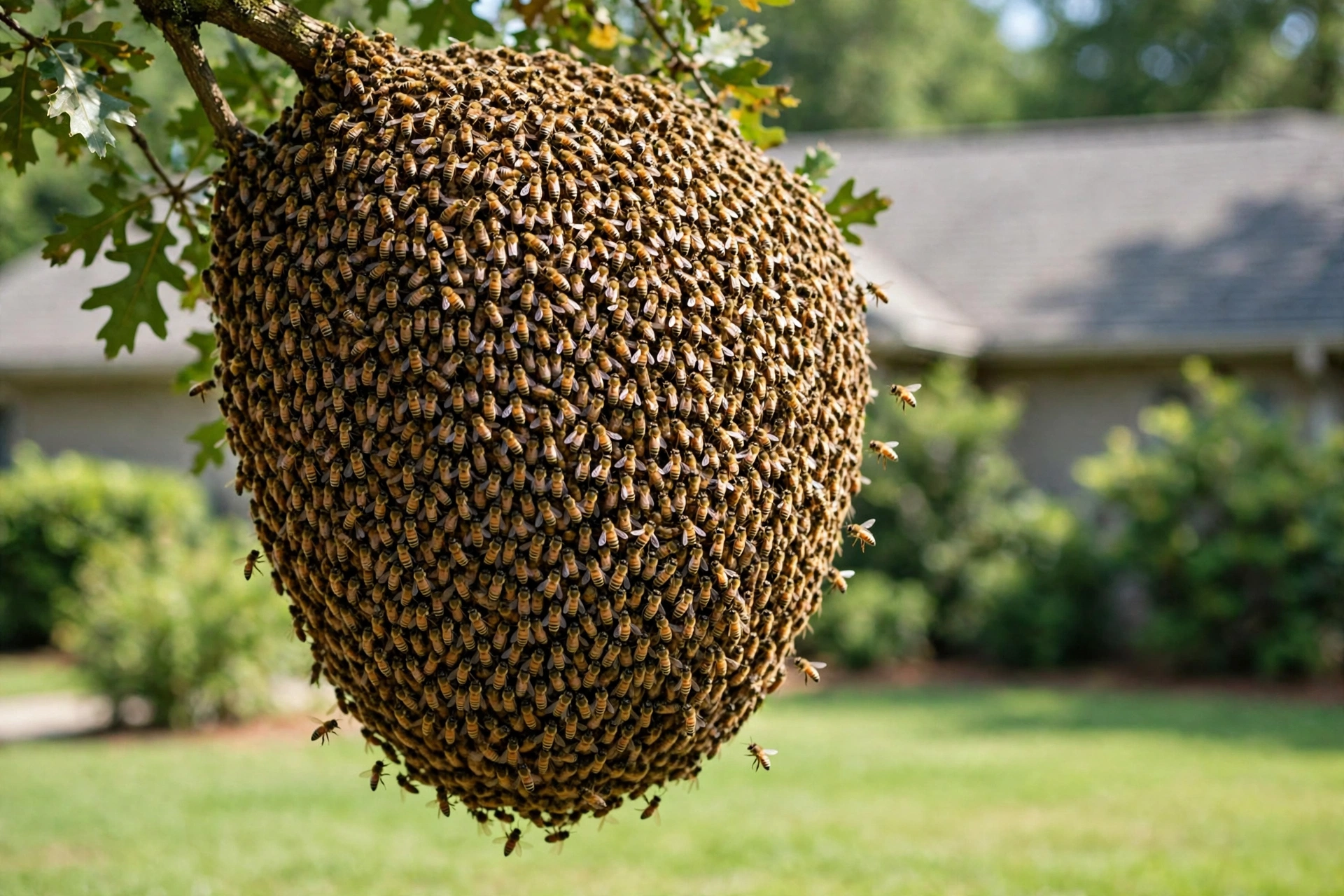
A football-sized clump of bees hangs from a branch overnight, or bees stream in and out of the same gap in the soffit every day for weeks. Those are two different problems with two different fixes, and mixing them up is how a simple beekeeper pickup becomes a wall cutout. Here is how to tell a swarm from an established colony, how to tell a honey bee from a yellowjacket, and what to do first in Hinesville.
Key Takeaways
- A cluster hanging in the open is a swarm, resting while scout bees find a home. It usually moves on within about 24 hours, and a beekeeper can often collect it free or at low cost.
- Steady traffic in and out of one gap, day after day, with bees carrying pollen, means an established colony with wax comb inside. That is a cutout, not a pickup.
- Honey bees are fuzzy and gold-brown and sting once. Yellowjackets are smooth, bright yellow and black with a pinched waist, and sting repeatedly. The fix is different for each.
- Never spray a honey bee colony inside a wall and leave the comb. Honey leaks, the comb draws ants, rodents and wax moths, and the wax smell draws the next swarm.
- Call the same day you see bees. A swarm caught before it moves into a wall is a pickup; the same bees a week later, inside the wall, are a cutout.
What Is a Honey Bee Swarm, and Will It Leave on Its Own?
A swarm is a colony on the move, resting while scout bees search for a permanent home. It has no comb, no brood and no stored honey to defend, so swarming bees are relatively gentle, but they should still be treated with caution. Most clusters move on within about 24 hours. If the swarm is near people, pets or a doorway, do not wait for it to leave: call a beekeeper or your county Extension agent the same day.
Honey bee colonies reproduce by swarming. During midwinter the queen begins laying eggs, and by spring the nest is congested with new bees. The colony raises a new queen, and the old queen flies away accompanied by more than half the bees. That flying swarm temporarily clusters on a branch, a fence or an eave while scout bees search for a permanent nest site, which is often a hollow tree, an abandoned hive, or, unfortunately, a hollow spot in a house.
University of Georgia Extension guidance for a swarm on your property is simple: do not disturb it, keep children and pets away, and if it is safely located away from people and animals you may wait for it to fly away on its own. If the swarm poses a real risk to people or animals, find a local beekeeper who will remove it. Not all beekeepers collect swarms, and some may charge a fee. Your county Extension agent can refer you to local beekeepers who collect swarms. A swarm does not stay put for long: a cluster usually moves on within a day or two, sometimes within hours, so if you want it collected, call soon. In Georgia, colonies may be preparing to swarm by the beginning of March, or even earlier in south Georgia, so Hinesville swarm calls start early.
A clump of bees hanging in the open is a swarm. Bees going in and out of a hole in a wall, a tree or a structure are an established colony. That one distinction decides everything that follows.
Is It a Honey Bee, a Yellowjacket, or Something Else?
Most of the stinging insects people call bees are not honey bees at all, and the wrong identification sends the wrong person to the job. Beekeepers do not remove wasps. Pest control companies do not relocate honey bees. Use this table first, from a safe distance, and never get close enough to catch one to check.
| Insect | Look | Nest | Sting | Who to call |
|---|---|---|---|---|
| Honey bee | Fuzzy, gold-brown, about 1/2 inch, thick waist | Wax comb in cavities, walls, attics, hollow trees | Stings once, barbed stinger stays in the skin | Beekeeper for live removal |
| Yellowjacket | Smooth, bright yellow and black, pinched wasp waist | Papery nest in the ground, in walls or in voids | Stings repeatedly, will chase | Pest control company |
| Paper wasp | Slender, reddish-brown, long dangling legs in flight | Open umbrella-shaped paper nest under eaves | Stings repeatedly if the nest is disturbed | Pest control company |
| Carpenter bee | Large, shiny black abdomen, loud buzzing | Round holes bored into bare wood | Males cannot sting; females rarely sting | Pest control for wood damage |
Honey bees drink nectar and eat pollen, and they make honey. Yellowjackets eat insects and scavenge meat and sugary food, which is why they turn up at picnics and trash cans in late summer. Honey bees build wax combs; yellowjackets and paper wasps build papery nests. A honey bee colony survives the winter on stored honey, while a wasp colony dies off and only the queens survive. If the insect at your door is smooth, bright yellow and black, and hanging around food, it is almost certainly a yellowjacket, and our wasp and hornet removal page is the right next read.
One more check matters: foragers carrying pollen on their back legs, flying steadily in and out of one opening, mean there is comb, brood and stored honey inside. That is an established honey bee colony, whatever the insect looked like at a glance.
Bees in a Wall: What Is an Established Colony?
An established colony lives inside a cavity and has built comb. You will see steady traffic in and out of one opening, often with foragers carrying pollen, and the same gap stays busy for more than a couple of weeks. Wall voids are attractive to swarms looking for a home, and once a colony builds comb in one, the cavity stays attractive: the wax and honey smell draws the scouts of the next swarm, especially if a cavity has had bees in it before.
Removing an established colony is called a cutout, and it is skilled work done in the evening, when all the bees are back in the nest. A specialist locates the nest cavity, opens the wall, soffit or ceiling at that point, vacuums the bees into a transport box, cuts out every piece of comb and transfers it to frames, and collects the remaining bees, often leaving the hive box overnight so foraging bees can find the queen. Then the cavity is scraped clean, the structure is rebuilt, and the entry points are sealed. The comb is the part that matters: every piece must come out. Comb left in a wall keeps leaking honey, and in warm weather unventilated combs may melt and stain interior walls. The dead brood and honey draw ants, rodents, wax moths and robbing bees from other colonies, and the pheromone trail left behind invites the next swarm.
A trap-out is a slower alternative sometimes used for colonies that cannot be opened up: a one-way cone over the entrance lets foragers leave and not return, and the colony depletes over four to six weeks. It is slow, it does not remove the comb, and it is not the first choice for a colony inside a living space. For most homes, the cutout is the job that ends the problem once.
Who Should You Call: Beekeeper, Pest Control, or Extension?
| What you see | Who to call | What happens |
|---|---|---|
| Swarm clustered on a branch, fence or eave | Local beekeeper, or county Extension for a referral | Live pickup into a hive box; often free or low-cost, because the beekeeper keeps the colony |
| Bees in and out of a wall, soffit, attic or chimney | Beekeeper who does cutouts, working with a carpenter or mason | Cutout: bees and all comb removed, cavity cleaned and sealed |
| Yellowjackets, paper wasps or hornets | Pest control company | Paper nest treatment; beekeepers do not remove wasps |
| You cannot tell what it is, or it is near a school or hospital | County Extension agent first | Identification and a referral to the right specialist |
Here is how bee help works through us in Hinesville. Call (912) 205-2930 and describe what you see, or send a photo taken from a safe distance. We identify the insect first, because the identification decides the job. Honey bees go to live removal through a local beekeeper, with the comb removed and the entry points sealed behind the work. Wasps and hornets get treated as wasps. And if a colony cannot be reached alive, or it poses an immediate danger, the comb still comes out: killing the bees and leaving the comb is the outcome that costs more later, not less.
Many pest control companies avoid colonies inside walls, because the work needs unusual expertise and carries liability risks. That is why the UGA Extension guidance points homeowners toward a beekeeper and carpenter team specialized for this work. The right question on the phone is not how fast someone can spray, but who removes the comb.
Why Does Spraying Honey Bees Usually Make It Worse?
Spray kills the bees and leaves everything they built. The comb, the honey, the brood and the wax smell stay in the wall, where honey leaks through drywall, the comb draws ants, rodents and wax moths, and the next swarm's scouts find a cavity that already smells like home. Insecticide only really works on bees that moved in a day or two ago, before comb is built. On an established colony, spray is the start of a bigger job, not the end of one.
There is a second problem with spraying a colony in a wall. Poisoned honey harms the bees from other colonies that come to rob it, and a colony killed and left in place can spread disease to robbing bees. The bees defending an opened nest are far more aggressive than any swarm, so a sprayed colony that is then opened up for comb removal is handled by someone in a full bee suit, with a plan, not by a homeowner with a can. Do not spray a swarm either: a swarm a beekeeper would have collected for free becomes a dead colony on the ground, and the swarm's scouts may already have marked your wall as their next home.
If you find a colony within a day or two of it moving in, before comb is built, call the same day and say so. That timing is the one case where the job may still be simple. Every day after that, the comb grows and the job grows with it.
What Should You Do If You Are Stung?
Most stings hurt, swell at the spot, and settle. The danger is an allergic reaction, and it does not wait for a second sting to announce itself. If a honey bee stings you, scrape the stinger off the skin quickly with a fingernail, a credit card or gauze. Do not squeeze it with tweezers: squeezing the venom sac pushes more venom in. Wash the area with soap and water, apply a cold pack to reduce swelling, and walk calmly away from the area so you are not stung again. Yellowjackets and wasps can sting repeatedly, so distance matters even after the first sting.
Call 911 immediately, and use an epinephrine auto-injector if one is available, if the person has difficulty breathing, hives spreading beyond the sting, swelling of the face, throat or mouth, wheezing, difficulty swallowing, dizziness or a sharp drop in blood pressure. Those are signs of anaphylaxis, a severe whole-body allergic reaction that is life threatening without prompt treatment. Antihistamines work too slowly and do not substitute for epinephrine in a severe reaction. Even if epinephrine has been given, call 911 or go to the hospital, because a reaction can return. Anyone stung many times, or anyone with a severe reaction, needs medical care and follow-up with a doctor or allergist. A past sting with only local pain does not guarantee the next sting will be the same.
When Is Swarm Season in Georgia?
| When | What happens | What to do |
|---|---|---|
| Late winter | Queen begins laying; colony population grows | Seal entry points before swarm season starts |
| Early spring (March in south Georgia) | Colonies prepare to swarm; new queen raised, old queen leaves with more than half the bees | Watch for clusters; call a beekeeper the same day you see one |
| Spring into summer | Swarms cluster, scouts search, colonies move into wall voids | Do not wait: a swarm today is a cutout next week |
| Summer | Established colonies grow; comb, brood and honey build up | Cutouts; comb removal and sealing after removal |
| Fall and winter | Colony survives on stored honey; activity slows in cold | Seal gaps and remove old comb so spring scouts find nothing |
Swarm season is spring, just before and during the main nectar flow, and in Georgia colonies may be preparing to swarm by the beginning of March, or even earlier in south Georgia. Hinesville sits in the warm part of the state, so treat March as the start of swarm season, not the middle of it. A cluster found in March is not early. It is on time.
How Do You Keep Bees Out of the House?
Prevention is mostly sealing, and it works because a swarm's scouts are looking for a cavity that is already the right size and shape. University of Georgia Extension guidance is to caulk potential entry sites, including knot holes, gaps around eaves and any opening into a wall void, and to cover ventilation openings with screening. Keep window and door screens in good repair, seal gaps where pipes and wiring enter, and repair loose soffits and fascia before spring.
After a removal, the cavity must be cleaned of comb and wax residue and sealed shut, or the next swarm will find it. An empty cavity that smells of wax and honey is exactly what scouts look for, and a colony removed without its comb invites the next colony in the following spring. If a wall has had bees before, that wall is a known address: seal it properly the first time, and check it again the next spring.
Do not leave a beehive, a swarm trap or an open compost of sugary waste near the house and expect the bees to stay in it. Bees follow scent and opportunity. The house with sealed gaps and no old comb is the house the scouts pass over.
What Are the Most Common Bee Mistakes?
- Spraying a swarm. A beekeeper would have collected it, often for free, and the sprayed bees leave no colony behind to keep, only a mess on the ground.
- Sealing bees inside a wall. Caulking the gap while the colony is inside traps thousands of bees, and they will find another way out, often into the living space.
- Treating every stinging insect as a bee. Yellowjackets need pest control, honey bees need a beekeeper, and the wrong call wastes days while the colony builds comb.
- Waiting to see if a colony leaves. A swarm leaves. An established colony does not. Two weeks of steady traffic at one gap is a colony, and every week of waiting is more comb.
- Removing comb without a bee suit and a plan. Bees defending an opened nest are far more aggressive than a swarm. Comb removal is specialist work.
Frequently Asked Questions
Do honey bees have to be removed alive?
There is no Georgia rule that makes live removal the only legal option for every honey bee job, the way bats are protected. But live removal is the standard UGA Extension recommendation, and it is the practical choice: a beekeeper takes the bees, the comb and the queen out together, the colony goes to a hive, and the cavity is cleaned and sealed. Killing a colony inside a wall without removing the comb leaves honey, wax and brood in place, which leak, draw pests and invite the next swarm. Where a colony cannot be reached alive, or it poses an immediate danger, a licensed pest company handles it, and the comb still has to come out.
How long will a honey bee swarm stay?
Usually about 24 hours, sometimes only a few hours, sometimes two or three days. A cluster is resting while scout bees search for a permanent home, and once the scouts agree, the swarm leaves together. Do not wait it out if the swarm is near people, pets, a doorway or a play area: call a beekeeper or your county Extension agent the same day. If the cluster is still there after a day, it may have found its home nearby, often inside a wall, and the job has changed from a pickup to a cutout.
How much does honey bee removal cost in Hinesville?
It depends on which job it is, and that is why the first question is always swarm or colony. A swarm pickup by a beekeeper is often free or low-cost, because the beekeeper keeps the colony, though some beekeepers charge a fee for the service. A cutout of an established colony is priced after seeing the cavity: where the comb sits, how much wall must be opened, how much comb and honey must come out, and what rebuilding and sealing the cavity needs. Ask what the quote covers: bee and comb removal, cavity cleaning, rebuilding and sealing are different parts of the job, and the written quote should say which are included before work starts.
Can a honey bee colony be relocated?
Yes. That is what live removal is. A beekeeper collects a swarm into a hive box, or cuts a colony out of a wall with its comb and queen, and moves it into beekeeping equipment at an apiary, where it can go back into honey production or pollination. Relocated colonies are the reason many beekeepers collect swarms for free. A trap-out, where a one-way cone lets foragers leave over four to six weeks until the colony depletes, is a slower relocation method that does not remove the comb, and it is not the first choice for a colony inside a home.
What if bees are in my chimney?
Do not light a fire to drive them out. Smoke and heat can push bees deeper into the house, melt comb onto the flue, and create a fire risk, and a chimney colony still leaves comb behind. Call for an inspection first: a chimney colony needs a specialist who can work the flue safely, often with a chimney sweep, and the chimney must be capped and sealed after removal so the next swarm cannot move in. If bees are coming down the chimney into the living space, keep the fireplace doors closed, keep people and pets out of the room, and call the same day.
Are Africanized killer bees in Hinesville?
You cannot tell an Africanized honey bee from a European honey bee by looking at it, and that is the honest answer for any swarm. University of Georgia Extension guidance says that if Africanized bees are known to be in your area, honey bee swarms should be reported to your county Extension agent or the state Department of Agriculture, so authorities can collect the swarm for testing. Treat every swarm with the same caution either way: do not disturb it, keep people and pets away, and let a beekeeper or Extension assess it. Do not assume a swarm is safe because it looks calm, and do not assume it is Africanized because it looks large.
Will bees come back to the same wall?
They will if the comb and the gap are left behind. Scout bees investigate cavities that have held colonies before, drawn by the wax and honey smell, and a cavity left open after a removal is an invitation for the next spring. Full comb removal, cleaning the cavity of wax residue, and sealing every entry point is what stops a return. Repeat bees at the same gap mean the cavity was not cleaned or not sealed, and that is what a follow-up check is for.
I was stung once and only swelled a little. Am I safe next time?
Not necessarily. A past sting with only local pain, swelling and itching does not guarantee the next sting will be the same, and an allergy can develop over time. The warning signs that need 911 and epinephrine are difficulty breathing, hives spreading beyond the sting, swelling of the face, throat or mouth, wheezing, dizziness or a sharp drop in blood pressure. Anyone who has had a severe reaction, or who was stung many times, should follow up with a doctor or allergist, carry an epinephrine auto-injector if prescribed, and tell the people around them where it is kept.
The Bottom Line
A swarm is a colony looking for a home, and it usually leaves within about a day. A colony in a wall is a colony that found one, and it does not leave. Tell them apart by what you see: a cluster hanging in the open, or steady traffic in and out of one gap. Tell a honey bee from a yellowjacket by fuzz, color and nest. Then call the right person the same day: a beekeeper for honey bees, pest control for wasps, and Extension when you are not sure. The comb decides the cost, the timing decides the job, and the sealing decides whether it comes back.
Sources
Found a Swarm or Bees in a Wall?
Identification first · Beekeeper live removal for honey bees · Sealing after removal
About Us
Hinesville Pest Control is a local, Hinesville-only service for termites, cockroaches, mosquitoes, ants, rodents and bed bugs. We know how coastal Georgia storms, humidity and PCS moves bring pests inside. Our promise is simple: written prices, licensed technicians, and homes that stay pest-free.
Our Address
🏢 Hinesville Pest Control
938 Elma G Miles Pkwy
Hinesville, GA 31313
Areas We Serve
Serving Hinesville & Liberty County
- Hinesville
- Fort Stewart
- Richmond Hill
- Midway
- Walthourville
- Allenhurst
- Flemington
- Ludowici
- Riceboro
- Gum Branch


